



‘Celebrating gold going parabolic is like bragging about how fast your ambulance is going. You’re still in the back bleeding.’
— Wolf of All Streets, X.com
Gold recently touched US$5,590 an ounce. Silver’s up 260% in a year.
If you own precious metals, you’re probably feeling clever right now. But before you pop the champagne, consider what this rally actually signals.
Because when precious metals run this hard, it’s rarely a sign that everything’s going swimmingly.
The Debasement Trade
That’s the term doing the rounds in financial circles.
The term rose into the public zeitgeist three months ago after a Guardian piece. You can see the Google search for the term spike around that moment.
And you can see its second wave now:
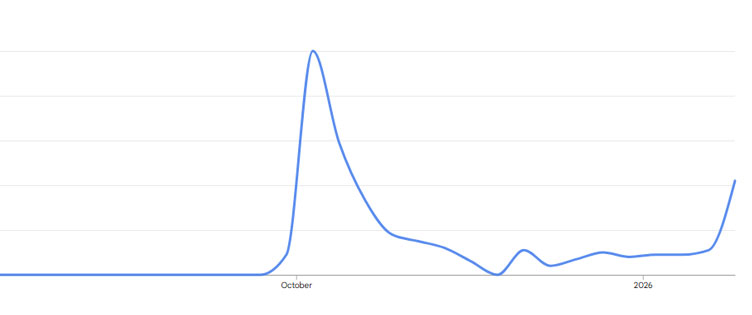
Source: Google Trends
For those late to the party, this trade describes investors fleeing traditional assets like government bonds and currencies in favour of hard assets on fears that sovereign debt is spiralling out of control.
You could zoom out to a larger geopolitical story about a global reshuffle, de-dollarisation, BRICS and China. But with my limited space, I’ll stick to the metals.
Those traditional hard assets. Gold, silver, and all the commodities that we’ve seen flying this past month.
Uranium spot prices have gone vertical. Copper just posted its fastest one-day jump in 16 years, and almost every commodity in between is now up double digits.
No one at Fat Tail is surprised by which assets are running. But few expected the move to be this fast — or this violent
In my eyes, that’s rarely a healthy sign.
We’ve talked about this before. I even warned of this moment back in June last year, saying:
‘Debasement is Next
Investors must recognise that governments will continue to outspend and systematically devalue our money.
The story is the same in Australia as our deficit deepens. The mathematics here is inescapable.
With interest payments consuming an ever-growing share of federal revenue and political will for meaningful cuts non-existent, monetary debasement becomes the path of least resistance.
Central banks will be pressured to accommodate fiscal recklessness by money printing, effectively taxing savers and fixed-income holders through inflation.
This environment demands defensive positioning. Traditional safe havens like government bonds offer little protection when governments are the source of monetary instability.
That’s why investors need to head back to the ‘classics’.
Gold remains the timeless inflation hedge.’
The debasement isn’t new, of course. It’s been running for five decades, since Nixon decoupled the dollar from gold in 1971.
Since then, currencies have been backed by nothing but faith. And that faith is wearing thin as we face down another potential wave of inflation.
Consider something as mundane as a can of Campbell’s tomato soup. A pantry staple turned cultural mirror. Inexpensive, reliable, warming.
In one sense, it represents security, convenience, and post-war frugality. In another, its unchanging form offers us a nice glimpse into the past.
That is, soup cans resist the usual trick of shrinkflation. The creeping reduction of product size rather than price increases.
In 1970, a can of soup cost around 10 US cents. Today, it’s pushing past $2.
That’s not inflation in the abstract. That’s the steady erosion of purchasing power, compounding year after year.
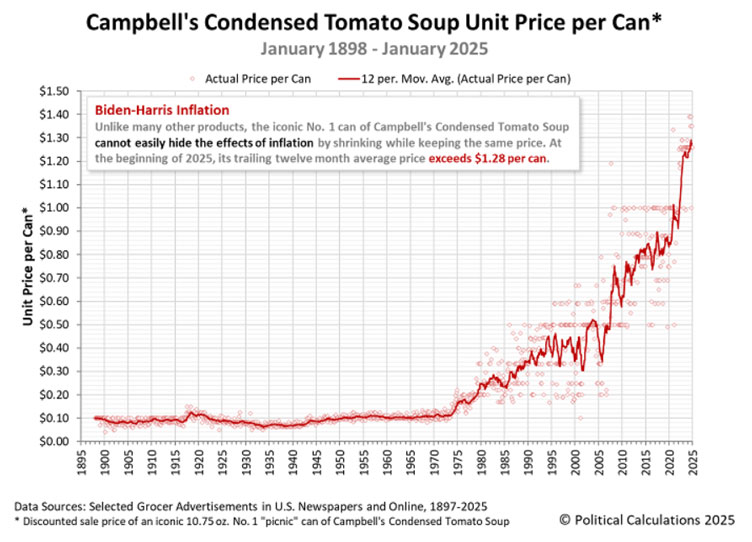
Source: Political Calculations
[Click to open in a new window]
Gold’s surge is simply the market’s way of acknowledging what central bankers won’t say out loud. Money ain’t what it used to be.
A Warning
Here’s the hard truth about precious metal rallies. They’re warning lights, not victory laps.
When investors pile into precious metals, they’re expressing deep unease about the financial system.
They’re hedging against the risk that central banks have lost control of the inflation they created.
This is the harvest of a system that inflated nominal wealth while quietly eroding purchasing power.
Those with the capital to hold leveraged assets have seen a multi-decade structural tailwind. Those who relied on labour saw their purchasing power flitter away.
We’ve seen the top 1% of the US go from owning 23% of the household wealth in the 90s to over 31% today.
Little surprise, then, that the gap between consumer sentiment and stocks is at a 40-year extreme.
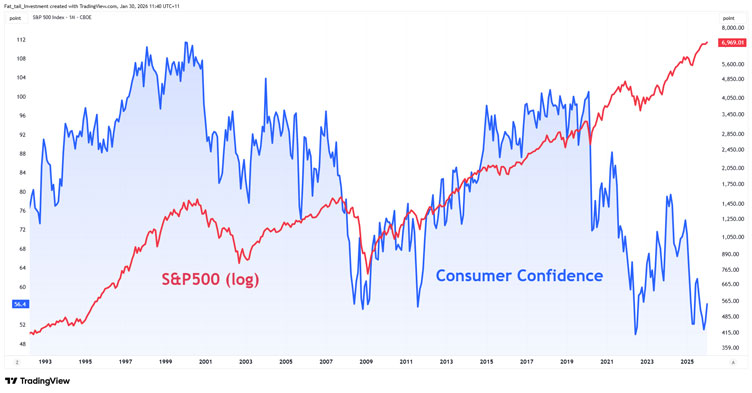
Source: TradingView
[Click to open in a new window]
It’s not just households that are feeling unease. Governments are piling into precious metals hand over fist.
To me, this signals that the security of the post-war international order is coming to an end.
It doesn’t matter if you want to label what comes next as regionalisation, or some other $5 word.
(Even that saying has seen inflation. It used to be a ‘fifty-cent word’.)
Regardless, the post-war order is breaking down, and suddenly everyone’s talking about sovereign risk.
Here’s where it gets tricky.
The debasement trade is now mainstream precisely because it’s already worked.
By the time a trade becomes consensus, the easy money has been made, and speculation now reigns supreme.
As I’ve covered in the past, in our hyper-connected world, the herd is moving in ever-tighter step. That should raise some red flags for you.
And there’s another wrinkle of history that many don’t account for.
The Gold Grab
Let’s say you’re right. Let’s say the debasement accelerates, currencies collapse, and your stack of gold and silver proves prescient.
Here’s the problem: history suggests you may never get to use it.
When precious metals work too well as a hedge against government incompetence, governments have a habit of taking them away.
In 1933, Franklin Roosevelt signed Executive Order 6102, making it illegal for American citizens to hold gold. Turn it in or face prison.
In Weimar Germany, as hyperinflation spiralled, authorities demanded gold for war reparations. Refusal meant decades in jail.
China’s 1950 decree forced all private gold to be surrendered to the state. The penalty for resistance? Labour camps, or worse.
Britain requisitioned gold during World War II. India banned private ownership in 1962.
The pattern is consistent. Every major economic power, when pushed to the brink, has confiscated gold from its citizens.
The very moment your hedge proves most valuable is the moment it becomes a target.
Gold bugs rarely account for this. They imagine a scenario where paper currencies collapse, and they emerge triumphant, trading gold coins for real assets.
But history suggests a different outcome.
You either sell early enough to convert your gains into something harder to seize, or you hold too long and watch it disappear into government coffers.
What Comes Next?
I’m not saying sell all your gold tomorrow. Precious metals remain a legitimate part of a diversified portfolio, particularly in an era of fiscal profligacy.
But the current rally deserves scepticism, not celebration.
Gold at record highs is the market screaming that something is wrong. With government balance sheets, with central bank credibility, with the post-war financial order itself.
And if that ’wrong’ ever becomes catastrophic, the very asset you’re counting on may be taken from you.
The debasement trade has worked brilliantly for those who got in early. But as with all trades that become consensus, the risk-reward is shifting.
For investors, all I would say is diversify thoughtfully. Don’t chase momentum.
And remember that in a true crisis, governments don’t play by the rules.
All that glitters is not golden.
Regards,

Charlie Ormond,
ATLAS and Altucher’s Investment Network Australia




Comments