




It was 3am Sydney time on Wednesday morning when I woke from a strange dream.
No, it wasn’t about the world coming together in peace. It was unrelated and therefore not worth mentioning here.
Anyway, I figured I would scroll through my phone quickly to see what was going on with the news and the markets. (Hint: Don’t do this if you want to have a good second half round of sleep!)
What caught my eye were reports about Iranian civilians standing around key power infrastructures and bridges. They stood there to prevent the US military from bombing them and their facilities.
This was an unconventional move. Some say these people came voluntarily, while others claim they came at the threat of death to be human shields for the Iranian Ayatollah regime and their Iranian Revolutionary Guard Corps enforcers.
Either way, this put the US and Israeli leaders in a bind. Would they proceed to follow through with this threat and risk committing a war crime in front of the world watching? Or negotiate a ceasefire?
Rationality prevailed. There were negotiations and an agreement for two weeks of ceasefire. The Strait of Hormuz will reopen temporarily, though orderly passage will take time as hundreds of ships and tankers queue up in this area.
This moment will certainly go down in history.
However, this chapter isn’t about to end. There may be more fighting ahead until the parties reach a mutual agreement, which will involve high-stakes demands from both sides.
Going beyond commentary on the conduct of this campaign and what could transpire, I want to discuss how the events in Iran might be something the Chinese Communist Party is taking careful note of.
The events in Iran may foreshadow a scenario that the Chinese ruling elite fears could happen in their country.
Moreover, how the US has conducted its operations in Iran and Venezuela shows a completely different type of warfare and strategy employed.
Information warfare in the 21st century
The advent of the internet during the turn of the millennium has evolved to a point where social media is prevalent worldwide.
People no longer need to consume information from specific broadcasters and programs. These days, we’re all effectively reporters and on-the-ground journalists if we want.
This means the world is able to watch historic moments in real time.
Warfare isn’t just about overcoming a region with troops and military equipment. One can wage a psychological and informational war aimed at courtingyou’re your enemy’s populace, not just subduing their army and commanders.
My article last week demonstrated this, with many readers leaving their comments, some in agreement and others in vehement protest. We’re all targets of the informational warfare. How we shape our opinions depends on the information we consume. We may succumb to our emotions or intellectual/ideological bias.
What’s interesting is that most of the time, we don’t know the author’s intention. We may become unwitting victims of a psychological or ideological operation.
The brutal reality of living
in a totalitarian regime
I was born in Hong Kong and lived there till I was 7. I remember waking up on the morning of 5th June 1989 to my mother crying out in horror in the living room as she watched the reports of the night before in Tiananmen Square.
Our family had been concerned about the prospects of the handover of Hong Kong to Mainland China in 1997. My parents had been applying to migrate overseas. The Tiananmen Square massacre cemented my parents’ resolve to migrate to Australia, which we did in September that year.
Living in Australia has allowed us to enjoy the relative freedom that we had experienced in the British Colony of Hong Kong. We have the additional privilege to vote, which Hong Kong residents don’t.
Many in the West take for granted their relative freedoms. I say this as I’m aware many Western countries have started to shift into a nanny state where their freedoms are replaced by privileges and restrictions. We ridicule our leaders for sport, with some going further to wish unprintable things happen to them, usually without legal recourse.
This contrasts starkly with totalitarian regimes like China, North Korea, Iran, etc. Thought is suppressed, let alone expressing it in public or in print. And gathering to express dissent is a gamble one’s life and even their family’s freedom.
We saw earlier this year how hundreds of thousands of Iranian civilians marched in the streets against the Ayatollah regime. Initially, there was hope that the Islamic theocrats would read the writing on the wall and enable a peaceful transition of power.
That wasn’t to be. The Iranian internet blacked out, the regime implemented a most brutal crackdown, and tens of thousands of protesters lost their lives.
The imminent fall of the Iranian
regime – it’s in their messaging
The world could only watch in horror as footages slipped out from the country, leading to much outrage.
While world leaders spoke out against the Iranian regime, nearly all were willing to just talk but not follow through.
Out of the multitude of nations, Israel and the US stepped in with their decapitation strikes.
Before you step in to correct me, spare me your rationalising.
Neither Israel nor the US struck Iran out of an altruistic motive to save its people from their rulers. Israel did this to settle scores over its vendetta over many generations. The US came in to consolidate its interests in the Middle East and strike a death blow to the competing Belt and Road Initiative that was set up by the BRICS nations.
We’re over five weeks into the conflict. Fighting is largely through kinetic warfare (missiles, drones, airstrikes) rather than conventional combat between standing armies.
Many observers have said that the US cannot defeat Iran without a full-scale ground invasion. They also believe that Iran will imminently win this conflict because of their ability to use cheaper equipment against its technologically superior opponents.
While theoretically true, the Iranian regime’s behaviour appears to suggest this is probably not the case.
What many outside of Iran don’t understand is that its governing body is more divided than it conveys. The deaths of Ayatollah Khameini, members of the theocratic leadership and IRGC leaders through targeted strikes have decentralised command. A civilian government exists, comprising a combination of loyalists to the Ayatollah and those who are more moderate. The civilian government has limited power, which belongs to the Ayatollah and the IRGC.
Signs of their division aren’t obvious, but one can detect them by looking at how President Trump and the Iranian state media communicate. The conflicting stances and messaging from both sides aren’t a reflection of President Trump’s mental instability (sorry to get your hopes up). It’s likely that different members are talking through the Iranian state media, and it’s not a unified front. President Trump’s tone may depend on the US military’s assessment of whether the Iranian representative wishes to escalate or de-escalate tensions.
It’s entirely possible that Iran is undergoing a regime change during this period, accelerated by the decapitation strikes. We won’t know until later, but the conflicting signals suggest more likely than not that the Iranian regime is crumbling, with factions vying to take over.
A warning to totalitarian leaders
Since the Wuhan virus pandemic, almost every country’s economic and social stability has deteriorated. The Russia-Ukraine conflict exacerbated this further, revealing that the energy and resources consumed by the West come from countries hostile to it.
Totalitarian regimes are particularly vulnerable in this period because the rulers need to control their people. The ruling party’s survival is by force, and their leaders often won’t hesitate to use it against the populace.
Prior to decapitation strikes seen this year in Venezuela and Iran, a totalitarian regime may feel relatively safe. Domestically they need to have military support while internationally they can rely on their allies to veto or condemn any foreign nations wishing to intervene.
This has changed.
Venezuela and Iran have shown that the existing rules-based order is merely moot. Moreover, if a country has resources or something that is attractive, there merely needs to be a pretext for an invasion. Though, we saw it before in Iraq, Afghanistan, Libya, and other countries in the last thirty years, the use of decapitation strikes in lieu of ground invasion changed the calculus.
And I suspect that President Xi and the Chinese Communist Party elites are studying this closely. The Chinese economy is weak, the populace is restless due to a failing property market and declining living standards. Add to that the military technology it boasted to the world proved virtually ineffective in Venezuela and Iran.
Should Iran’s regime change and become more friendly to the US and its Western allies, this will be a significant hit on its economy. For decades, the government pinned its hope for maintaining social stability through a stable, growing economy. It also deters dissent by projecting an image of an intimidating internal security and military force, and its vast surveillance network.
All these are now looking shaky. How will the rulers deal with a people who are seeing through the illusion while surrounded by countries watching to see if they can exploit this weakness?
The coming months will see more breathtaking, if not scary, developments. However, rather than let your emotions and imagination run wild, it’s time to consider how to position yourself to benefit from the uncertainty and volatility.
As the dynamics in the Middle East are set to change, this will impact the financial system.
If you want to prepare ahead of time, I invite you to read my recently completed book, Gold’s True Message: A Guide to Building Wealth in a Failing Monetary System.
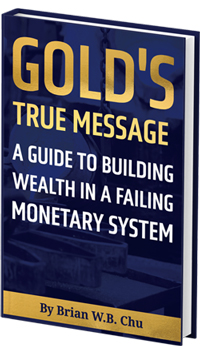
Along with this book, you can learn how to build a precious metals portfolio to protect your purchasing power and grow your wealth with a subscription to The Australian Gold Report.
You can find out more by clicking here.
I hope you enjoyed this article. There’s more than meets the eye in what’s unfolding. Stay tuned and enjoy the weekend ahead!
God Bless,

Brian Chu,
Gold Stock Pro and The Australian Gold Report




Comments