




I remember my awakening. It began around 2013. I noticed that the mainstream media was pushing narratives that had no resemblance to with the world around me.
I started to question the economic data. Especially the assumptions used for the metrics. For example, the consumer price index (CPI) was rising much slower than prices I experienced at the grocery store and at the petrol station. And the employment rate double-counted people who had more than one job.
Often, they’d taken on the second job to deal with the higher cost of living the government was denying…
Put simply, the bureaucrats were playing with the numbers to help politicians spin a narrative. The journalists could then heap praises on their enlightened friends for something they didn’t do.
It was hardly an early awakening. Some of you may’ve known much earlier. And therefore had to put up with the frustration for longer.
But what if I tell you that you’re not alone. In China, there are over a billion people who feel the same. Moreover, they’re used to this. The only difference is that they live under a regime that is more oppressive. Resistance is largely futile. They don’t speak about it, at least until recently. But they’re all aware of it.
What’s changed though? In recent times, the people themselves are openly telling the world that they’re overworked, poor, and fed up.
If you look in the right places and listen to the right people, their economy is in dire straits. And the people are on the brink:

The squeeze you’re feeling from the higher cost of living caused by a higher interest rate, a weakening job market, and property prices cooling down is likely nothing compared to what the ordinary Chinese people are experiencing. Their outlook is so bleak many have pretty much given up.
The only people who buy the narrative that China’s outlook is bright and it’ll be the biggest driver of the world’s economy are some western analysts, and the rank and file (certainly not those at the top!) of the Chinese politburo.
Today’s article will briefly cover key elements about China’s society that many western analysts miss when they study its economy.
Top-down planning – when
numbers dictate reality
Before you continue, it’s important that I put this caveat out there.
I don’t believe that China’s capitulation is imminent. There are signs of weakness in domestic spending and investment. As well as a loss of confidence from the populace due to falling property prices, as you can see below:
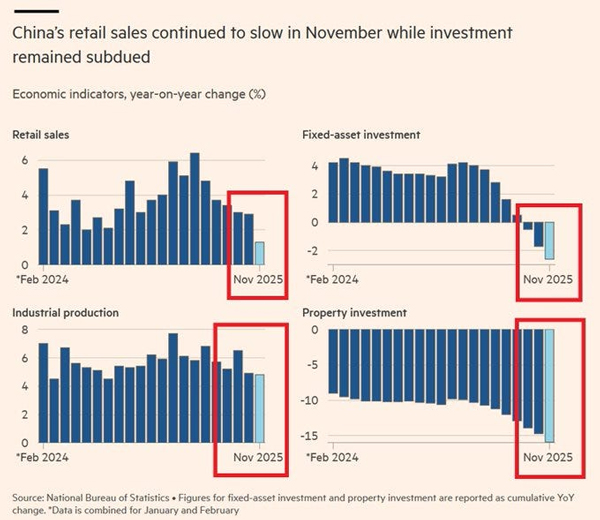
Source: The Financial Times
However, the Chinese economy will chug along and attempt to turn this weakness around. The government will seek to push state-owned enterprises to fill the gap and spur domestic consumption, by hook or by crook.
Think of it this way. Those who were bearish on our own property market since the subprime crisis (myself included!) were on the wrong side of history for a long time. It’s only in the past year that we’re finally seeing the steam come out of our markets.
Therefore, positioning yourself for a China collapse too early could burn you.
Now let’s get to the main point.
We know that our economic data aren’t that reliable. The government agencies manipulate data by changing definitions over time. They report the headline figures and then quietly adjust them in subsequent periods, when political accountability has waned.
But China takes it to a different level. The data isn’t just unreliable. It serves an entirely different purpose to what we think it should.
Keep in mind that the Chinese Communist Party sets long-term plans and goals. This sounds well and good.
Except it dictates reality ahead of time – such as deciding how much the economy will grow at the start of the year.
Moreover, when it decides the growth rate, it must be accomplished. Failure is not an option.
To achieve this requires manipulation, Chinese style.
That’s why, for many years, China imported vast amounts of resources to build ghost cities, thousands of miles of high-speed rail, and manufacture excess amounts of items prescribed and subsidised by state-owned enterprises operating on a mandate.
All these activities fulfil the purpose of showing that the government achieved their goals. China can claim that it made the grade, while western economies would need to wait after the period ended to see if they met their goals.
However, this practice leads to an imbalanced economy and a warped society. But before we get to that, let me tell you about another quirk in how China operates that the West doesn’t fully understand.
When image matters over profits
Many Western analysts understand to some extent the grievances that the Chinese ruling party airs out about its past.
The ‘Century of Humiliation’ they call it – starting from the Opium War to World War 2.
While some of the Chinese people feel the indignation, the CCP emphasises this as a rally cry. It hopes to divert attention from the catastrophic failures perpetrated by Mao’s rule from 1949-1976 that likely killed more people than those who died during 1839, when the Opium War broke out, to 1945, when the Japanese surrendered and they ended their occupation.
What the West doesn’t understand about the Chinese mindset is that indignation and loss of face can permeate their decision-making for centuries.
On the constructive side, the Chinese sought to vindicate themselves by channelling their much-revered conscientiousness into productivity and scholastic achievement. There’s no denying that the Chinese economy transformed in a major way since the economic reform under President Deng Xiaoping. And Chinese test scores and IQ levels are substantially above the world’s average.
However, this conscientiousness may be misguided via central planning from the ruling party. When the ends justify the means, there’s productivity. But the top-down approach as mentioned before leads to excessive production of certain goods, causing waste and resource misallocation.
These don’t contribute to wealth creation, but the opposite.
To the outside, China displays an exemplary economy. The ruling party is resolute in its strategic direction, driven by past indignation. The people are hard-working and motivated by a leadership with clear goals that they collectively accomplish.
But inwardly, China is facing increasing decay that is becoming harder to hide. The rulers struggle with corruption and internal strife. The people are overworked and poor, with a substantial proportion who have given up (there is a growing movement of people who are ‘tangping’ or ‘lying-flat’).
The result is an economy marred by inflation, excess capacity in some sectors and under-utilisation in others. Corruption have spurred wealth inequality while excess speculation in the property market has ruined many households and while younger people are reluctant to start a family.
China’s situation is best characterised by a famous ancient saying ‘gold and jade on the outside, corruption and decay on the inside’.
Turning its destiny or a last hurrah?
Despite listing out the fundamental issues with the Chinese economy and the psychology that drives it, I’ve said that betting against China’s boom in the coming months mightn’t pay off well.
The reason is that there is still steam in China’s economy, despite all its problems. Moreover, the ruling party recognised that its practices may have contributed to its current predicament.
In a recent economic conference last year, President Xi criticised this longstanding practice of manipulating data and managing by the numbers. He claimed it stifles real growth and contributes to significant wastage. He is seeking a turnaround via more investment to high-tech industries rather than cheap, low-quality goods. And he wants to spur confidence in the people to spend more to absorb excess production.
Whether this is simple posturing or a genuine step to turning over a new leaf remains to be seen.
But for a country that puts its image above everything else, there is an even greater motivation to turn things around.
With the Trump administration putting greater pressure through tariffs and destabilising its allies to cripple it financially and militarily, China must act smart or face capitulation.
One thing it can do is to utilise its position as the world’s factory and strategic supplier of critical materials. Therefore, expect China to spur the commodities market, whether it’s to negotiate mutually beneficial deals to unleash a new industrial revolution or to force the global supply chain into a stalemate.
Whatever it does, I expect that commodities will be the story for 2026.
I’m going to wrap up here for this week. Join me next week as I delve further into the Chinese mindset and reveal the major hurdles it needs to overcome if it wants to avoid going down the same path as the Soviet Union 40 years ago.
God Bless,

Brian Chu,
Gold Stock Pro and The Australian Gold Report




Comments