



Yesterday, the Prime Minister stood up at the University of Sydney and delivered his biggest AI policy shift to date.
The speech was titled ‘AI in Australia’s interests’. The throughline was that the era of hands-off AI policy is over:
‘The expansion of AI requires a physical, material footprint.
It needs our land and energy and computing power to operate.
That means we can set the terms, we can determine AI’s social licence.’
He went on to outline plans for new laws on AI standards, with the headline measure targeting data centres.
In a similar vein, just hours before his speech, the State of New York imposed a one-year moratorium on new data centres.
Plenty have piled on, attacking the NY plan, but locally it’s popular. Residents have seen electricity prices increase by 68% since 2019.
It seems Albo isn’t content waiting for a backlash; things are about to change. And these carry real weight for anyone watching Australia’s energy transition.
From expectations to obligations
In March, the government released a set of ‘expectations’ for large data centres. Projects that met them would jump the approvals queue. Projects that fell short would wait.
Those expectations had no legal force. Now, Albo’s new plan would convert them into mandatory national standards.
Under the proposal, the next generation of large-scale AI data centres must:
- Put at least as much energy into the grid as they take out
- Build new renewable generation and firming capacity to do it
- Pay their full share of grid connection costs
- Minimise water use and fund extra water infrastructure they need
The net-generator rule is the one that matters most. Every large AI facility built here would need to come with its own power project.
It’s important to note that, for now, these are proposals, not law.
National Cabinet meets next month to seek agreement from the states. Legislation is slated for early next year, but I wouldn’t be surprised if that timeline slips.
The Business Council is already pushing back. It wants the optional March framework to stay optional, warning that mandatory rules could push investment offshore.
Plenty could change between here and the final stamp. But the direction of travel looks set.
A forced buyer
Consider what the net-generator rule actually does.
It bundles an energy project into every large data centre. The developer must fund new generation, firming and grid connection before the servers switch on.
That creates a class of buyers that cannot walk away. Anyone building AI compute in Australia must also buy renewable capacity, batteries and transmission work.
Demand of that kind flows through a long supply chain. Solar and wind developers. Battery and firming providers. Electrical contractors, grid engineers, and switchgear suppliers.
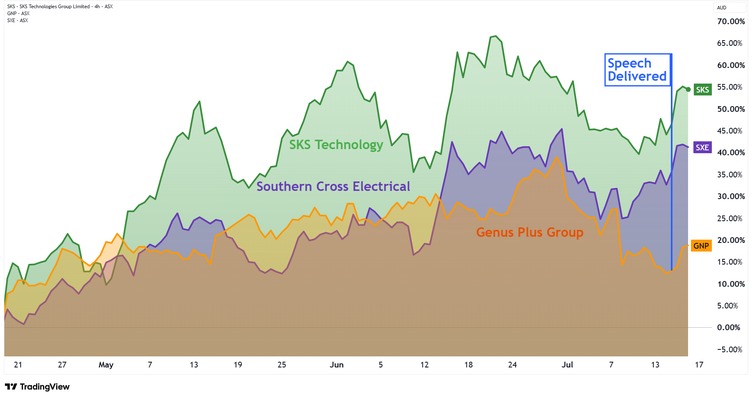
No surprise then, that three of our biggest public electrical contractors closed up by 5%.
Source: TradingView
[Click to open in a new window]
None of these businesses needs to pick the winning AI model. They get paid no matter which hyperscaler comes out on top. Because the buildout itself is the product.
The scale on offer is significant. Anthropic alone is reportedly seeking 1.4 gigawatts of Australian data centre capacity, at a build cost of up to $21.6 billion.
There is also a timing mismatch working in suppliers’ favour. Data centre designs are fairly standard and modular. Many go up in 18 to 24 months.
Grid and renewable projects often take five to ten years. Firms that can deliver energy infrastructure quickly will be massive winners.
Claims worth testing
One line in the speech deserves scrutiny. Albanese said, ‘the world is queuing up to invest in Australia’.
Some evidence backs him. In a 2024 survey, Australia ranked second only to the US as the most attractive destination for data centre investment.
But in two years, things can move. And the numbers show the local boom is smaller than the rhetoric suggests.
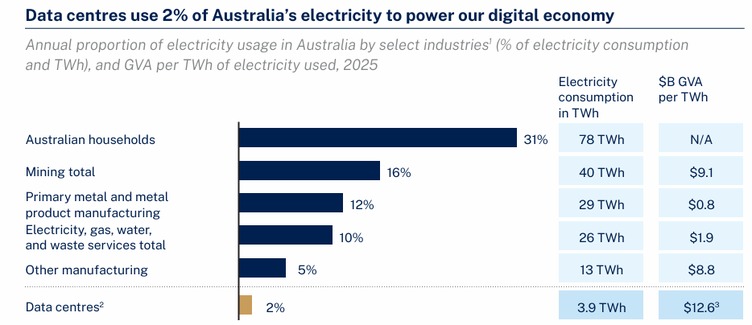
Australian data centres consumed around 3.9 terawatt-hours in FY25. That is roughly 2% of grid-supplied electricity in the national market.
Compare that to mining, which uses 16% of the grid. Metals manufacturing uses 12%.
Source: AEMO – Mandala
[Click to open in a new window]
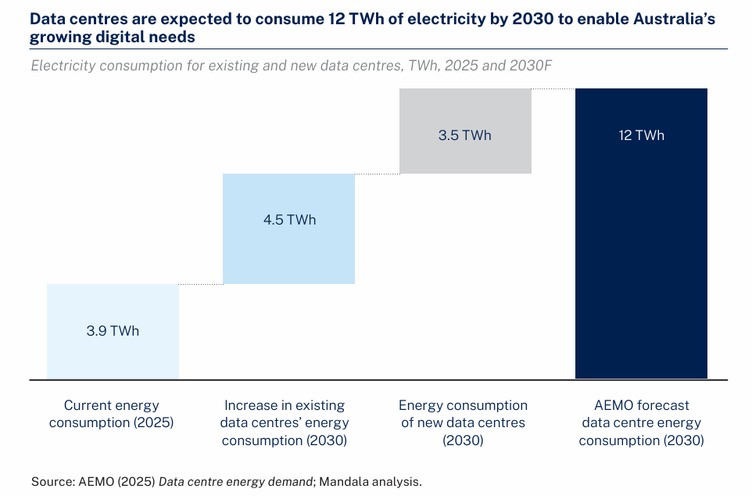
Current projections have data centres accounting for 6% of grid supply by 2030.
That’s roughly a tripling of total terawatt hours (TWh) from 2025 to 2030, eventually reaching 12 TWh.
Source: AEMO – Mandala
[Click to open in a new window]
But projections here are fuzzier than many would have you believe. Let me explain.
In the background, there’s a turf war going on. On the back of rapid growth in cloud services and surging ambitions from the hyperscalers, planners have gone into overdrive.
Realising that power is a major constraint, data centre planners have flooded our energy market with connection requests.
The logic here is straightforward. Get your foot in the queue for power requests, then sort out the rest. If things don’t eventuate, the administrative costs are peanuts compared to the lost opportunity.
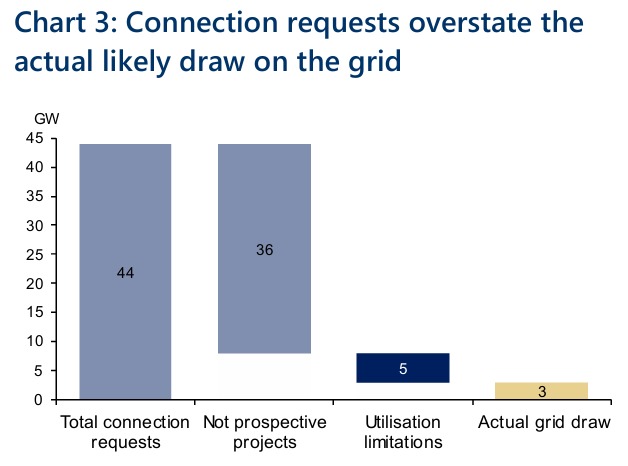
Looking at 2025 data, we can see the extent of this so-called ‘phantom demand’. For 2025, six of every seven megawatts in early-stage connection requests fail to materialise.
Source: Oxford Economics
[Click to open in a new window]
For some scale, those 44 GW of connection requests are equivalent to the world’s total AI data centre power demand for 2026. Not all of these requests are coming from data centres, but there’s clearly some shenanigans going on.
Power aside, capital also has other doors. AirTrunk, an Australian-founded operator, just committed $42 billion to data centres in India rather than here.
Mandatory rulings undoubtedly raise the cost of entry, and no other country has legislated a single national framework like this.
It’s not that I’m immediately opposed to the idea. Being first can mean setting the terms. But it can also mean watching capital route to cheaper jurisdictions.
Australia’s appeal and leverage are real, but untested. Land, sun, minerals and stable institutions are genuine advantages.
Whether they outweigh compulsory obligations is the question the next 18 months will answer.
There’s also an open question about how far the government will wade into AI’s potential societal impacts. The speech’s rhetoric was selling a light-touch policy.
However, this government’s impulse has often been to reflexively overreach.
If the rules pass and the capital still comes, the energy buildout expands and the suppliers win.
If the capital goes elsewhere, the losers are likely to be the data centre landlords rather than the grid builders. Many have a decade of transition work ahead of them either way.
Next month’s National Cabinet meeting will give us the first real signal.
Regards,

Charlie Ormond,
ATLAS and Altucher’s Investment Network Australia




Comments