



Yesterday I told you that Musk’s third moonshot is a robot.
And I also said that the REAL money in it probably won’t land where most expect.
Not Tesla shares, not SpaceX.
To answer the WHERE question on the robot money, let me take you back sixty-five years.
That was when a machine called Unimate turned up for its first shift at a General Motors plant in Ewing Township, New Jersey.
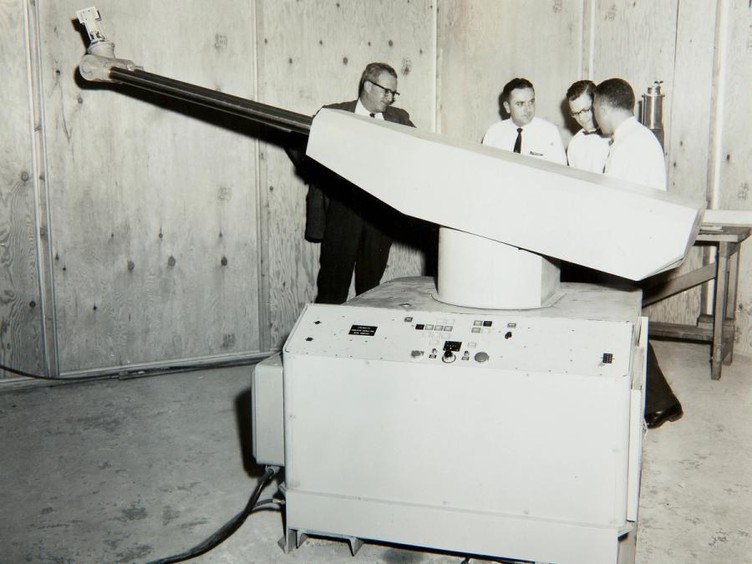
Source: Robots Guide
Unimate was the world’s first industrial robot, a hydraulic arm weighing about 1.8 tonnes.
Its job was the one no human wanted, even in 1961.
Lifting red-hot die castings out of a press and welding them onto car bodies.
That work had already cost line workers fingers, lungs and occasionally their lives.
Unimate worked around the clock.
It never complained.
It never asked for a pay rise, a smoko or a holiday.
Five years later, it turned up on American television, pouring a beer and sinking a golf putt for Johnny Carson.
A machine that could pour a beer without spilling it was enough to stop a nation in 1966.
But this is the key insight on what it means for your money…
And it goes straight to the Australian side of my Musk robot thesis for 2027.
You see, Unimate’s George Devol filed the patent seven years before that arm lifted a single casting.
His business partner, Joseph Engelberger, had to market HARD around Detroit before General Motors finally said yes.
General Motors is remembered as the company that installed the first industrial robot.
It is not remembered as the only company that got rich from it.
A fair share of the money went somewhere far less glamorous.
It went into the hydraulics that made the arm move, and then over decades, the manufacturers building the actuators, drives and sensors saw the real money.
What eventually grew up in Unimate’s shadow is an industrial automation industry worth tens of billions of dollars a year.
Run mostly by firms nobody outside the industry could name.
So here’s the pattern.
The company that puts on the show is rarely the company that owns the bottleneck underneath it.
I think we’re about to watch it happen again, at a scale Devol and Engelberger could never have imagined.
Musk has a magnet problem
That’s the idea sitting underneath my new thesis, ‘Elon’s Final Moonshot’.
Musk wants to build millions of humanoid robots. Eventually billions.
And it started with a quiet shift last year at a single plant.
Tesla ended production of the Model S and Model X at its Fremont, California, then spent months converting that line to build Optimus instead.
That’s right…
A car company pulled a car line out of a car factory to make something that walks.
There are constraints though, and Musk has already told you where they are.
It all comes down to MAGNETS.
Every joint in a humanoid robot needs its own motor.
Every motor needs its own magnet, and the rare earth elements that make those magnets strong enough to survive inside a robot’s elbow…
Well, they come almost entirely out of one country’s processing plants.
Tesla can design the robot.
Tesla cannot mine the rare earths.
Scale it up and the numbers get serious.
One estimate puts a single humanoid robot at 3.5 to 4 kilograms of high-performance magnet, roughly double what goes into an electric car.
A million robots a year works out at around 2% of global NdPr production, for just one company’s product line.
That may not sound like much, but smaller shifts in demand have tilted bigger commodity markets into price overdrive before.
And then there’s the fact that Optimus is not the only humanoid in this race.
Figure and Agility are building them in the US, Unitree and a queue of others in China, arguably faster.
So even if Optimus disappoints, demand for the raw material does not walk out the door with it.
I’ll still be expecting it to pour my beer, just like Unimate could.
Hopefully with a bit of personality too.
Jokes aside, the main problem in investing circles is that most people chasing this story treat the bottleneck as a Tesla risk.
The actual reward lies in ancient wisdom.
The oldest play in the book
The obvious play is Tesla shares, if you believe the story.
But buying the thing the flashy company can’t build itself is hardly an original idea.
Instead, it’s the pick and shovel play, which is wisdom as old as the gold rush.
Heck, during Australia’s original gold rush, Ballarat merchants selling literal picks, cradles and flour did better on average than the blokes standing in the mud.
(True story: my mother comes from Ballarat merchant stock — Dad’s were dirt farmers buying off Mum’s merchant forebearers)
Ironically, it was my Dad who bought TSLA shares at 16 bucks.
So generational fortunes CAN change.
And we know a lot of the lasting money from the dot-com build out went to the companies laying fibre optic cable, rather than the websites running over it.
That same idea in the AI boom has turned a previously unglamorous chipmaker into one of the most valuable companies on earth (NVDA).
I reckon it goes the same way with Musk’s robots.
So I’ve spent months working back from the components to the raw geology underneath them.
Everyone is arguing about actuators and chips right now.
Almost nobody is asking what those parts are actually made of.
The chip still needs a certain metalloid. The sensor housing still needs a magnet.
The actuator still needs an alloy that holds its strength at temperatures that ordinary steel cannot survive.
And the West holds a comfortable position in almost none of it.
There is one exception, and that’s lithium for the robot batteries.
But market share there is still a fraction of China’s.
Here’s what I’ve done
I’ve built a new research report around four small, largely unheard of ASX companies sitting on exactly that layer.
The rock underneath the components everyone else is already talking about.
Unimate sat in a patent office for seven years before it lifted anything.
I don’t think we get seven years this time.
Maybe just a year or two. Likely no more than three.
The full case is in a free presentation, including the mechanism, the risks and more about the four companies I think sit at the bottleneck.
Watch Elon’s Final Moonshot, free
Tomorrow, I let you in on the person quietly bankrolling Elon’s robot magnet mines.
Warm regards,

Dr. Lachlann Tierney,
Australian Small-Cap Investigator and Fat Tail Microcaps




Comments