



“…being specific is the essence of lawmaking and the whole difference between having a congress and having a mom.”
— P.J. O’Rourke
Beijing has spent the past six weeks telling us exactly what it’s not going to do.
The Politburo met on 30 July and called for ‘pragmatic incremental measures’ and ‘stronger counter-cyclical adjustment’.
There is a certain magic to how boring the CCP can be in its announcements. In a country that almost completely revolves around the party’s decisions, reading its verbose, dull policy papers is a part of doing business.
In fact, DeepSeek, one of its powerful AI labs, started as a hedge fund project to crunch the tens of thousands of CCP documents each day to find an investing edge.
Well, if you’re looking for an edge today, it’s fairly dull. It announced no new funding envelope, no change to the deficit and no move on rates.
Three commentaries have since run in the People’s Daily under the pen name ‘Zhong Caiwen‘, a name widely read as a proxy for the Central Financial and Economic Affairs Commission, which Xi Jinping chairs.
The message was blunt. China has not relied on heavy policy stimulus and does not intend to start.
They described their moves instead as ‘acupressure,’ small interventions aimed at specific weak points.
Anything larger, they argued, would lead to a form of ‘policy addiction’, a market hunting for the next handout.
Apparently, irony is dead in the Politburo…
Still, for anyone still waiting on the Aussie side for the Chinese reflation trade, maybe go enjoy your spring.
Why Anyone Expected a Bazooka
The case for a substantial package, a so-called stimulus bazooka, is not difficult to make.
Second quarter growth came in at 4.3%, the slowest reading in more than three years and well short of Beijing’s target.
The shape of that slowdown is another sore point to the central planners’ promises. Industrial output grew 5.4% in the first half, while retail sales managed just 1.3%.
Those retail numbers are grim, with sales falling for the first time since COVID in May and improving by only 0.6% last month.
Economists in China are using the same language of a K-shaped economy to define their consumption woes.
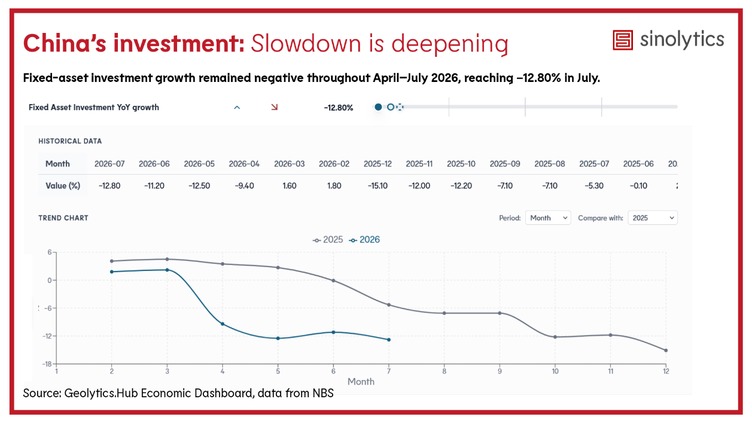
The investment numbers are worse. Fixed-asset investment has collapsed over the first seven months of this year, now down almost 13%.
Property dropped 19.2%, and infrastructure, the traditional shock absorber, fell 3.6%.
Source: Sinolytics
[Click to open in a new window]
Chinese steel output over those seven months fell 3.1%, with July alone down 3.6% to 76.9 million tonnes.
For another view of the pain, I’ve updated my China Japanification monitor.
Those are precisely the conditions under which previous Chinese governments opened the taps.
What Beijing Is Actually Doing
Money is being spent, but it’s a relative trickle for now.
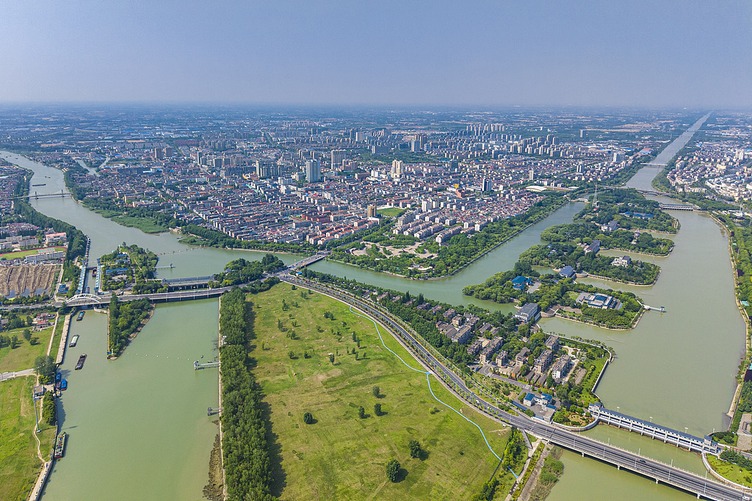
The latest infrastructure push is something called the ‘Six Networks’. Initially announced as a 15-year plan, it’s now being accelerated to five.
The five-year plan is estimated to cost roughly US$4 trillion and is the first time we’ve seen its major infrastructure plans bundled into one.
Scheduled for completion in the early 2030s, the plan spans water networks, power grids, computing infrastructure, next-gen communications, urban pipelines, and logistics.
Source: Jiangdu Water Conservancy Hub in Yangzhou
That US$4 trillion is starting with US$1 trillion earmarked for this year.
That’s a substantial sum, but they’re starting small. Just 800 billion yuan for now (~US$119 billion).
Set 800 billion yuan against a 140 trillion-yuan economy and you arrive at roughly 0.6% of annual output.
For some scale, its 2008 package was 4 trillion yuan, back when China’s economy was about a quarter of its current size.
The Part That Matters for Us
Size is only half the story here, because composition matters considerably more.
Start with where profits are already flowing inside China.
Industrial profits rose almost a fifth in the first half of the year. But non-ferrous (no iron) metals and oil-linked producers took most of that, with earnings in those sectors up more than 70%.
But if you look at where the new money is aimed and read that ‘Six Networks’ list again with a miner’s eye, what do you see?
Grids, interconnectors and computing centres are copper and aluminium projects.
Pipelines and waterworks consume steel, but nothing close to the tonnage in apartment towers.
The spending flows toward metals Australia has less of, and away from the ones we built the Pilbara around.
Iron Steady
Given all of that, the price has held up remarkably well. The iron ore benchmark has traded between US$93 and US$100 since June.
That floor is being held by supply rather than demand.
Vale has guided production down to 335–345 million tonnes and lifted its costs. Simandou is ramping more slowly than the bears feared, with Rio’s SimFer port not commissioning until early 2027.
Both of those tailwinds weaken over the next two years.
So a repeat of 2016 also looks unlikely. That reflation came from Beijing ordering state-owned steel and coal producers to cut capacity.
The anti-involution campaign now targets mostly private firms, which are far harder to command at that scale.
What It Means for the Big Three
The FY26 results were excellent for our big miners, which makes the current situation easy to misread.
BHP [ASX:BHP] lifted underlying EBITDA 27% to around US$33 billion. Fortescue [ASX:FMG] shipped a record 201.3 million tonnes and grew EBITDA 9% to US$8.6 billion.
But look at where BHP’s money came from. Copper delivered more than US$18 billion, or 54% of group underlying EBITDA, on a 70% margin. Iron ore contributed just over US$14 billion.
The market has already reached this conclusion. BHP shares are up roughly 40% this year and Rio Tinto [ASX:RIO] has gained about 20%.
Fortescue, the iron pure play, is down around a fifth and trades a quarter below its May peak.

Source: TradingView
[Click to open in a new window]
The Read for Aussie Investors
If you hold iron ore exposure on the view that Beijing eventually capitulates and stimulates, you have now been told repeatedly that it won’t.
Policy has shifted from defending a fake growth number to managing a transition. Officials say openly that cleaning up local government debt and property will cost them growth, and they’ll wear it.
None of this makes our miners bad businesses. BHP prints cash, and Fortescue’s costs of US$18.74 a tonne is world-class.
It does mean the bull case now rests on supply discipline rather than a Chinese demand recovery.
Beijing’s money is going into grids and data halls rather than skylines. Your exposure may need to follow it.
Regards,

Charlie Ormond,
ATLAS and Altucher’s Investment Network Australia




Comments