

If there is one big easy to remember idea I’ve got about the Aussie market it’s this:
“Sell the banks, buy the miners”
Note: this is not direct financial advice – it’s more a motto about the way I see the two largest parts of the Aussie market and economy evolving in the next 5-10 years.
Let’s break it down.
Why the Banks Could Suffer
The Australian real estate-banking complex faces serious constriction. The RBA may keep rates higher for longer.
And the concept of “mortgage prison” has become reality.
Borrowers are trapped under APRA’s rigid serviceability buffer. Banks are hiking variable rates outside the official cash rate cycle. This creates a toxic feedback loop.
Rising rates suppress borrowing capacity. They cool property prices. They threaten the collateral values underpinning bank balance sheets.
Commonwealth Bank [ASX:CBA] shows the historic valuation stretch. In mid-2025, CBA traded at over 30 times earnings. That’s nearly double its ten-year average of 17.
Other banks in the world don’t trade on multiples like that and it looks like a valuation top, not a sign of strength to me.
The recent 6% selloff following CBA’s quarterly earnings suggests the market is waking up to this reality.
Then there’s crypto – the existential threat that is sprinting across the horizon at CBA and the other parts of the government backed banking oligopoly in this country.
~31% of Australians now own cryptocurrency.
Commonwealth Bank caps crypto exchange transfers at $10,000 monthly. This debanking strategy backfires spectacularly. It pushes capital offshore.
It accelerates the rise of non-bank financial alternatives. Australian institutions will be forced to offer integrated crypto services or face irrelevance.
Over a 5-10 year horizon, I am rock solid confident that digital assets will systematically dismantle traditional banking fee structures and deposit franchises.
This represents permanent market share decay rather than cyclical headwinds.
The best the banks can do here is co-opt.
Why Resources Benefit
Resource stocks emerge as the clear winners in this environment.
They offer both inflation hedges and structural growth plays.
Let’s talk about copper.
The AI data centre buildout creates exponential commodity demand that dwarfs previous cycles. Microsoft’s Chicago facility alone required 2,177 tonnes of copper. That’s 27 tonnes per megawatt.
This represents just the beginning. Global copper demand from AI infrastructure is projected to increase by 1-3.4 million tonnes annually by 2030.
And data centre lithium-ion battery markets are exploding.
Meaning the electrification supercycle is extending beyond copper to the bruised darling lithium, even the forgotten cobalt, and potentially all the way down to the much maligned nickel.
With $1 trillion in US AI infrastructure investment projected by 2029, mining companies should see a decade of margin expansion as commodity prices will rise faster than production costs.
The confluence of monetary tightening and technological transformation creates a stark binary outcome.
Banks carry historic valuation risk while confronting existential crypto disruption.
Resources on the other hand, offer both inflation protection and leveraged exposure to the AI revolution.
There’s nothing wrong with Nvidia – but when it’s larger than the 10 largest mining companies in the world on a cumulative market cap basis…
The case for a historic and perhaps decade long rotation is plain to see.
For me, the evidence points to a multi-year rotation where real assets comprehensively outperform paper tech assets.
(You know, those hyperscalers that are spraying AI data centre capex everywhere.)
This trend has only just begun – if this resonates with you, check out what James Cooper says here.
Best Wishes,

Lachlann Tierney,
Australian Small-Cap Investigator and Fat Tail Micro-Caps
***
Murray’s Chart of the Day –
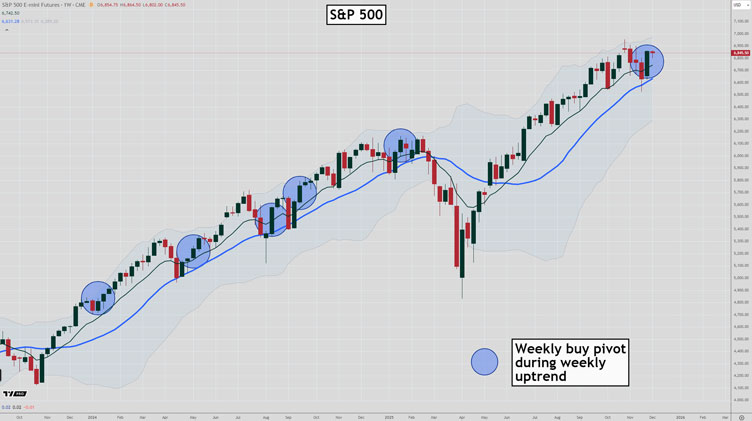
S&P 500

Source: Tradingview
After a month of selling pressure in the S&P 500, last week saw a nice recovery bounce that confirmed a weekly buy pivot.
That is interesting because a weekly buy pivot during a weekly uptrend, has a pretty good strike rate of predicting further upside.
To make my point, I have circled every time a weekly buy pivot was confirmed during a weekly uptrend over the last couple of years.
You can see how successful it is at picking up short-term reversals in momentum.
It worked four out of the five times it occurred during 2024.
The fifth time was just before a serious correction. But if you just had a rule to run away if a weekly sell pivot was confirmed you would have gotten out for a small loss and avoided the worst of the downturn.
So with that knowledge we can say the markets have switched back to a bullish posture as we head towards the Christmas trading period.
But all bets are off if the selling returns and a weekly sell pivot is confirmed.
So a 3-4% fall in the S&P500 can switch off the current bullish signal quite quickly.
But while it remains I will continue to hold positions and hope Santa arrives on his sleigh.
Regards,

Murray Dawes,
Retirement Trader and International Stock Trader





Comments