

Have you been trying to wrap your head around what’s going on in Venezuela?
As I keep reminding you, it is essential to view these geopolitical events in the context of resource supply.
What do I mean?
Well, in terms of Venezuela, forget about drugs; this is about locking in America’s future energy security.
Today, virtually ALL major global events have the supply of minerals or energy as their root cause.
And I believe that has been born thanks to decades of underinvestment in the basic building blocks of human civilisation.
I’ve covered this in depth over many editions in the past.
Commodities are essential. Without a reliable supply, tensions grow. Nations fragment, allies separate, and trade fractures.
The recent events in Venezuela are just one more example of the dozens of commodity-conflict-related events that we’ve covered in recent years.
And further evidence that governments have placed the supply of commodities as their primary agenda.
However, given the boldness of this latest event, we may be approaching a critical inflection point, where governments are becoming more assertive in their efforts to secure resources.
Why Venezuela?
There have been plenty of opinions on why the US made its surgical removal of the country’s leader in recent days.
No doubt, oil appears to be a key factor.
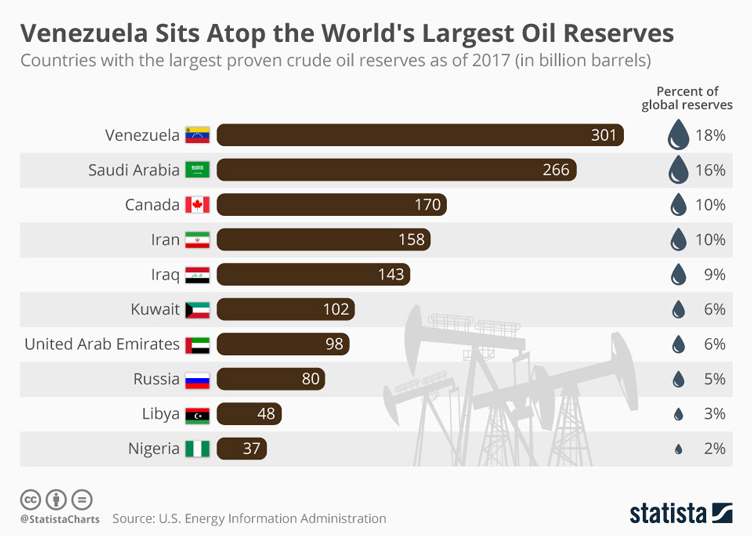
In fact, Venezuela contains almost a fifth of the total global oil reserves, making it larger than Saudi Arabia:
Source: Statista
[Click to open in a new window]
That’s why some analysts hint that America’s ‘intervention’ in Venezuela could lead to a sudden glut in oil supply as US producers tap into these vast reserves.
But as you know, that’s unlikely…
Like constructing new mines, developing oil wells takes years, plus the US will need to restore and expand Venezuela’s decaying pipeline infrastructure.
And that’s assuming the country can maintain civil and political stability.
More likely, this is America’s ‘long game’ as it attempts to secure new sources of oil to replace its ageing Permian Basin in West Texas and New Mexico.
Another Factor: Oils Ain’t Oils
You may be aware that the US is a major global oil producer, producing approximately as much oil as it consumes.
But there’s a kink in this American energy resilience… Not ALL oils are the same.
The US was once a major producer of a type of crude oil known as heavy sour.
Its oil infrastructure and refineries were built around the extraction and processing of these ‘heavy crudes.’
But today, US oil production is dominated by a ‘light sweet’ form of crude, which is sourced from the country’s prolific Permian Basin.
So, what’s the consequence?
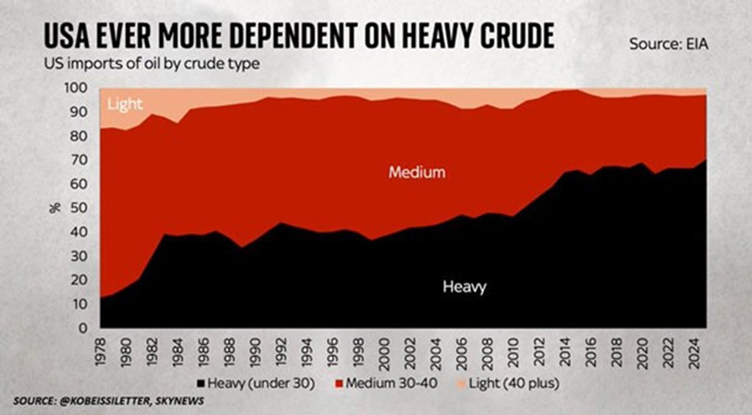
As bizarre as it may seem, despite the US being an oil-producing powerhouse larger than Saudi Arabia, it remains heavily dependent on oil imports, particularly heavy crude:
[Click to open in a new window]
Many US refiners can’t process locally sourced Permian Basin crude. To do so, they must blend the domestically produced ‘lights’ with the imported ‘heavies.’
So, how does Venezuela fit into this equation?
Well, according to Rystad Energy:
“Venezuelan oil is particularly dense and sticky. The high-sulphur crude more closely resembles a semi-solid tar than the far clearer liquids produced in US shale heartlands, making it more difficult to extract and process into gasoline, diesel, jet fuel and feedstock for the chemicals industry.”
However, Venezuelan oil is precisely what many refineries in the US were designed to process.
Hence, why I believe the Trump administration has zeroed in on the country.
To me, this is all about tapping into the country’s vast heavy crude supplies and establishing long-term US energy security.
We’ll keep a close eye on developments over the coming months and potential strategies to invest in this important theme.
Until next time.
Regards,

James Cooper,
Mining: Phase One and Diggers and Drillers




Comments