




As you’ll recall, last week, I was at the Diggers & Dealers event in Kalgoorlie.
Kal has historic gold roots from the 1890s, a prolific discovery era.
So, today, I thought I’d continue that theme, detailing what was perhaps the most famous gold discovery ever.
But, this time, it wasn’t in Australia, but the other side of the world, in Canada.
And this is where it starts…
In 1896, three lads named George Carmack, James Mason and his nephew, Charlie, headed north into Canada’s remote Yukon province.
With unemployment high, the three pioneers sought to make a living from the wild, untamed wilderness.
Fishing and logging their way through the depression years.
However, what followed not only changed the fortunes of these three men but also much of the economy across North America.
Making their way down the Klondike River in the remote Yukon Province of Canada, the trio followed a lead from an Indigenous legend…
It was rumoured that masses of gold sat along the bank of one of the many tributaries of the Klondike River.
But the exact location was uncertain.
Without any need for gold, the indigenous population never gathered the bounty here. What was the point for them?
But for the white man, this was Canada’s El Dorado, a vague myth offering fortunes for its finder… If it were true.
At the time, the Yukon territory (east of Alaska) was known to contain gold, and several isolated mining camps were scattered across the remote territory.
Plagued by its summer mosquitoes and biting flies, the three pioneers spent weeks hunting the many tributaries branching off the Klondike.
Eventually, the three prospectors stumbled upon one tributary called Rabbit Creek.
And from there, it didn’t take long…
The tale was true!
On August 17, 1986, at a sharp bend on the river, the trio stumbled upon a swarm of nuggets.
Golden nuggets!
As Johnny Horton, in his ‘North to Alaska’ classic, would sing:
‘Where the river is windin’ big nuggets, they’re findin!’
This discovery would kick off the famed ‘Klondike Gold Rush.’
The trio quickly pegged out their claim and registered it with the local police post.
Word quickly spread to nearby mining camps.
Within days, all the land surrounding Rabit Creek had been staked.
But wherever there’s gold, there’s sure to be more!
With the prized land taken, prospectors continued their hunt… Downstream, upstream.
It didn’t take long… Another swarm of nuggets even RICHER than the first was discovered.
Gold fever was about to grip the ENTIRE North American continent. In what would become the most intense gold rush ever known!
But with no means of long-distance communication, it took time for the news to flow thousands of miles south.
In fact, according to some sources, the story didn’t register with the public until a steamer pulled into port and unloaded its rich bounty in front of a jaw-dropping crowd.
Weeks after the initial discovery.
From there, the news broke like wildfire.
Tram drivers, steamship operators, farmers, loggers… gold fever spread fast!
Here’s a copy of an original news headline after the Steamer Portland arrived in Seattle:
| |
| Source: University of Washington Archives |
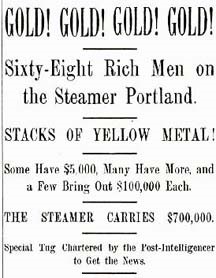
And this excerpt from the local paper, The Seattleite, dated July 17, 1897:
“Seattle is all ‘agog’ with this gold fever, and the streets are crowded with knots of men so worked up over the news that they can scarcely avoid being run over by the cars and carriages.”
But by 1897, ‘Klondike Fever’ hadn’t just struck Seattle but most of the North American continent.
With that… The great northern rush was on!
With at least one year’s supplies, prospectors jumped on dogsleds and made their way through the perilous snow and ice up Canada’s northern frontier.
The journey was made famous by Jack London, a young author who documented his travels up the Yukon from San Francisco.
Around 100,000 desperate hopefuls made the journey.
Some would perish, most would turn back.
Only about a third of those who left in 1897 would make it up to the Yukon goldfields.
Among those, a few became rich.
The Yukon Remains a Frontier for Explorers
The 1890s were a fascinating era for precious metals.
But to this day, Northern Canada remains one of the world’s largest untapped frontiers for new gold discoveries.
In fact, I tipped one stock to my readers that’s unlocked what could be the ‘source’ of the gold that fed the famous Klondike Gold Rush.
You see, every gold nugget has an origin; gold doesn’t start life as a nugget.
It starts deep underground, in the rock-bearing deposit.
And that’s what this company is trying to uncover: the motherlode that fed the prolific Klondike Gold Rush!
If you’d like to learn more, you can do so here.
Regards,

James Cooper,
Mining: Phase One and Diggers and Drillers




Comments