
• Skip to primary navigation
  • Skip to main content
  • Skip to primary sidebar
  • Skip to footer
  • Home
  • Latest
  • Videos
  • Series
  • E-Newsletters
    • Fat Tail Daily
    • James Cooper’s Mining Memo
    • The Daily Reckoning Australia
  • Categories
    • Commodities
    • Macro
    • Market Analysis
    • Small Caps
    • Technology
  • Investment Guides
  • Premium Services
  • Editors
  • About
  • Contact Us
  • Subscribe
Fat Tail Daily
Subscribe
  • Home
  • Latest
  • Videos
  • E-Newsletters
  • Premium Services
Latest

A Global Recession? It’s Only a Matter of Time (Part Five)

Like 0

By Jim Rickards, Saturday, 07 October 2023

Germany is the world’s fourth-largest economy, but will be of no help in stimulating global economic growth. Germany can barely help itself. Unlike China, the US, and Japan, Germany is not suffering weak growth: it’s already three quarters into a recession.

Wholesale prices fell in June 2023 by 0.2% month-over-month. This was the third straight monthly drop following May’s larger 1.1% decline. On a year-over-year basis, wholesale prices fell 2.9%, the most since June 2020.

Germany’s price declines are part of much broader deflationary trends there. The biggest source of German deflation comes from trade and business prices. This appears not only in internal wholesale prices but in export and import prices as well.

The global goods economy is being buffeted by declines in demand and dangerous overcapacity. And there are no indications the deflationary downside is steadying. There will be more demand destruction and deflation before the process bottoms out.

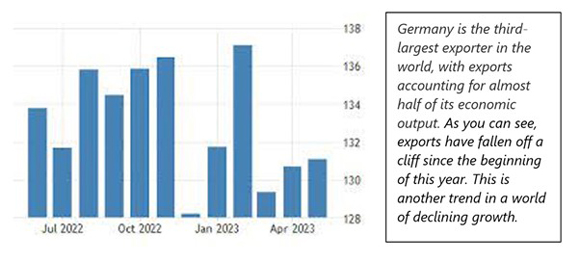
The value (in euros) of German exports in May 2023 was 3.5% less than May 2022. Adjusted for inflation, export volumes fell 7.9% year-over-year. Imports also dropped 10.2% in euros. Exports to the US fell 7.2% in May (on a year-over-year basis), the first decline by value since February 2021.

These trade figures must be put in the context that Germany’s net trade surplus as a percentage of GDP is higher than any major economy in the world. German growth is driven by exports. Since volumes have been falling longer than dollar or euro values, it’s important to look at levels in comparison with previous years.

German export volumes:


German export volumes chart

[Click to open in a new window]

Germany’s import and export volumes today equal what was shipped during each of the prior two economic recessions in 2012 and 2009, both notably weak years.

Until recently, this trade weakness had been hidden by the 2021–22 supply chain disruptions that kept nominal values solid, even as real activity fell dramatically. But as deflation hits trade, nominal margins shrink and turn negative. Business owners will have to equalise volumes, not values. There’s no resiliency here, just adaptation to a world of declining growth.

Germany has its hands full with declining output, declining exports, deflation, a looming energy crisis, and the consequences of its decision to follow Joe Biden into the quagmire of Ukraine. Its Nord Stream natural gas pipelines to Russia are off-line perhaps for years to come, and they have disabled their nuclear power plants and dismantled their coal-fired plants. Germany is also hindered by the slowdown in China, a prime export market.

Germany will not be rescuing the global economy. It can barely help itself.

Regards,

Jim Rickards Signature

Jim Rickards,
For The Daily Reckoning Australia Weekend

All advice is general advice and has not taken into account your personal circumstances.

Please seek independent financial advice regarding your own situation, or if in doubt about the suitability of an investment.

Jim Rickards

Jim’s Premium Subscriptions

Publication logo
Jim Rickards’ Strategic Intelligence
Publication logo
Fat Tail Investment Research

Latest Articles

  • AI Giveth, AI Taketh Away
    By Charlie Ormond

    Australia’s unemployment rate jumped to 4.5% in April. While WiseTech and Meta are the latest to cut thousands of jobs. The common thread? Artificial intelligence.

  • Markets Whipsaw as Yields Surge
    By Murray Dawes

    Charlie and Murray discuss the jump in bond yields around the world, the upcoming CGT changes, and the whipsaw in the ASX 200 this week.

  • After the Boom: Preparing Your Portfolio for a Fragmented World
    By James Cooper

    The Great Unravelling: Learn How the End of Globalisation Will Reshape Your Wealth

Primary Sidebar

Latest Articles

  • AI Giveth, AI Taketh Away
  • Markets Whipsaw as Yields Surge
  • After the Boom: Preparing Your Portfolio for a Fragmented World
  • Feels Like Everyone Has an Algorithm Except You
  • The bond market has a licence to kill you

Footer

Fat Tail Daily Logo
YouTube
Facebook
x (formally twitter)
LinkedIn

About

Investment ideas from the edge of the bell curve.

Go beyond conventional investing strategies with unique ideas and actionable opportunities. Our expert editors deliver conviction-led insights to guide your financial journey.

Quick Links

Subscribe

About

FAQ

Terms and Conditions

Financial Services Guide

Privacy Policy

Get in Touch

Contact Us

Email: support@fattail.com.au

Phone: 1300 667 481

All advice is general in nature and has not taken into account your personal circumstances. Please seek independent financial advice regarding your own situation, or if in doubt about the suitability of an investment.

The value of any investment and the income derived from it can go down as well as up. Never invest more than you can afford to lose and keep in mind the ultimate risk is that you can lose whatever you’ve invested. While useful for detecting patterns, the past is not a guide to future performance. Some figures contained in our reports are forecasts and may not be a reliable indicator of future results. Any actual or potential gains in these reports may not include taxes, brokerage commissions, or associated fees.

Fat Tail Logo

Fat Tail Daily is brought to you by the team at Fat Tail Investment Research

Copyright © 2026 Fat Tail Daily | ACN: 117 765 009 / ABN: 33 117 765 009 / ASFL: 323 988