
• Skip to primary navigation
  • Skip to main content
  • Skip to primary sidebar
  • Skip to footer
  • Home
  • Latest
  • Videos
  • Series
  • E-Newsletters
  • Categories
    • Commodities
    • Macro
    • Market Analysis
    • Small Caps
    • Technology
  • Investment Guides
  • Premium Services
  • Editors
  • About
  • Contact Us
  • Subscribe
Fat Tail Daily
Subscribe
  • Home
  • Latest
  • Videos
  • E-Newsletters
  • Premium Services
Commodities

Why Commodities Move in Packs — And What History Says Happens Next (Part II)

Like 1

By James Cooper, Friday, 13 March 2026

Commodities are surging across the board, and the real reason has nothing to do with the headlines you’re reading.

It started with gold in 2024.

Then, in 2025, rare earths, silver, platinum, and copper followed.

In early 2026, industrial metals like aluminium, zinc, and tin took their turn.

And now it’s oil, gas, and coal.

The batten is being passed from one commodity to the next, and no one can really explain why.

The daily news cycle proposes a surprise demand spike… A supply shortage… Or a geopolitical scare.

But it never goes to the heart of the cause.

The news cycle also doesn’t explain why different commodities rise (together) despite holding vastly different demand drivers.

Example #1

As I pointed out earlier in the week, demand for precious metals is tied to global uncertainty.

Industrial metals on the other hand are pegged to global growth.

Two groups of metals with opposing growth drivers, yet both are moving side-by-side:
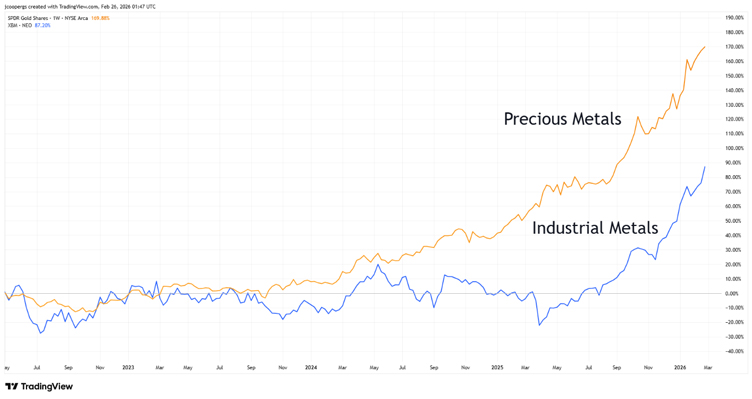
Source: Trading View

[Click to open in a new window]

Few acknowledge it, and even fewer can explain WHY it happens.

Understanding this market

As you may know, I’m a geologist who’s spent most of my career in the mining industry, from early-stage grassroots exploration to production.

I’ve worked across a bunch of commodities, from gold, copper, zinc, and iron ore. And despite the diversity of experience, job opportunities have tended to be all-or-nothing.

Either there’s an abundance of work on offer, or there’s hardly anything available. And when putting food on the table is dictated by commodity prices, you tend to pay close attention.

That experience has sent me down the rabbit hole of trying to understand the highly cyclical landscape of commodity markets.

A key part of what I do for my paid readership group is to look at history, specifically the events that drove past commodity upswings.

Whether that’s the gold rush of the 1890s, the outbreak of World War I, or the US Civil War. Rising commodity prices are interwoven with the most significant events in history.

That makes sense, after all, commodities are the foundation for building and maintaining economies.

No matter what innovation brings, we still need raw materials to build the infrastructure to develop new technologies.

That’s why I spend a lot of time trolling through old books, studying booms and busts, and paying special attention to commodity markets.

And throughout all that research, one common theme keeps reappearing:

The Answer

I’ve learned that the foundation for the upward move across the whole commodity spectrum is a lack of new supply.

And that’s driven by prolonged underinvestment in exploration and mining development.

You see, without future supply, the resource market falls out of balance and becomes exposed to EVENTS that drive prices higher.

And it’s these ‘events’ that get attached to rising prices… The headline stories that accompany price jumps.

But these events are not so much the CAUSE, just the catalyst that sparks prices higher.

So, the next time you read a bullish narrative about a certain commodity rising, whether it’s gold, copper or whatever…

Step back and think: why now?

The truth is, the foundation for higher prices was laid years ago: a lack of investment in new mines or new oil wells leading to an over reliance on existing and ageing supplies.

And that’s the real secret why commodities tend to move cyclically and in parallel with each other.

What happens next?

While the events colliding with rising prices may vary from cycle to cycle, like the Vietnam War of the 1970s or the China infrastructure boom of the early 2000s…

The underlying CAUSE never changes.

Underinvestment in new supply.

Once you understand that core principle, then you’re ready to take advantage.

It’s time to put your knowledge into action with real investments and protect your portfolio from an era of commodity inflation.

This is the place to start.

Until next time.

Regards,

James Cooper,
Mining: Phase One and Diggers and Drillers

All advice is general advice and has not taken into account your personal circumstances.

Please seek independent financial advice regarding your own situation, or if in doubt about the suitability of an investment.

Comments

Subscribe
Notify of
guest
guest
0 Comments
Inline Feedbacks
View all comments
James Cooper

James Cooper has been a working geologist in mines across Australia, Canada, and Africa since the early 2000s. He’s led the operations of tiny explorers through to huge producer outfits. He’s seen booms and busts firsthand and he also understands the cyclical nature of individual commodities. For example, James was right there when Barrick Gold launched an enormous $7.5 billion takeover bid for Equinox. That was the peak of the last cycle.

With his background as a geo and finance professional, he brings a unique insight and experience to Fat Tail Investment Research. He writes the broader resource-focused investing letter Diggers and Drillers and the ultra-speculative explorer-focused trading service Mining: Phase One.

James’s Premium Subscriptions

Publication logo
Diggers and Drillers
Publication logo
Mining: Phase One

Latest Articles

  • The Cockroaches are Multiplying
    By Charlie Ormond

    Six weeks ago, I asked whether private credit was the new subprime. Things are only looking worse since.

  • Green Light Still Pending
    By Murray Dawes

    Markets surged this week on news of a ceasefire in Iran. But a strict reading of the trading model suggests caution, with short-term risks still pointing to potential downside despite strong price action.

  • Part I: The Great Energy Pivot: How the Rules of Global Oil and Gas Are Being Rewritten
    By James Cooper

    The old energy order is fracturing. Decades of balance between buyers and sellers is unravelling — and the suppliers are winning.

Primary Sidebar

Latest Articles

  • The Cockroaches are Multiplying
  • Green Light Still Pending
  • Part I: The Great Energy Pivot: How the Rules of Global Oil and Gas Are Being Rewritten
  • The Chokepoint Always Wins
  • China Capitulation Part 9 – Rethinking a regime’s control over its people

Footer

Fat Tail Daily Logo
YouTube
Facebook
x (formally twitter)
LinkedIn

About

Investment ideas from the edge of the bell curve.

Go beyond conventional investing strategies with unique ideas and actionable opportunities. Our expert editors deliver conviction-led insights to guide your financial journey.

Quick Links

Subscribe

About

FAQ

Terms and Conditions

Financial Services Guide

Privacy Policy

Get in Touch

Contact Us

Email: support@fattail.com.au

Phone: 1300 667 481

All advice is general in nature and has not taken into account your personal circumstances. Please seek independent financial advice regarding your own situation, or if in doubt about the suitability of an investment.

The value of any investment and the income derived from it can go down as well as up. Never invest more than you can afford to lose and keep in mind the ultimate risk is that you can lose whatever you’ve invested. While useful for detecting patterns, the past is not a guide to future performance. Some figures contained in our reports are forecasts and may not be a reliable indicator of future results. Any actual or potential gains in these reports may not include taxes, brokerage commissions, or associated fees.

Fat Tail Logo

Fat Tail Daily is brought to you by the team at Fat Tail Investment Research

Copyright © 2026 Fat Tail Daily | ACN: 117 765 009 / ABN: 33 117 765 009 / ASFL: 323 988