

Circa ~30% of Australia’s oil supply passes through the Strait of Hormuz; once you trace the chain back through the Asian refineries we depend on.
More than 200 service stations in NSW, Victoria and Queensland have run out of at least one type of fuel.
It’s a concerning situation for the average Aussie.
More so for any business owner running a transport-dependent operation.
Yesterday I talked about a potential market apocalypse.
Today I talk about Trump’s mysterious present.
A present you say?
Trump told reporters in the Oval Office that Iran gave the US a “very big present worth a tremendous amount of money.”
“Yeah, it was related to the flow and to the Strait.”
Whether or not you believe him – the evidence was in the price (for now).
Oil fell on reports of the diplomatic push, with crude oil dropping below $89 a barrel.
The optimists had their moment.
There are risks
Don’t get too comfortable.
There’s evidence which suggests that even once the Strait reopens, it will still be 1.5 to 2 months before Asian refineries are at full capacity again.
Australia is exposed in a way most Australians still don’t fully appreciate.
Australia does not hold the mandatory 90-day fuel reserve requirement, something we have failed at since 2012.
We have two small refineries.
One in Geelong, one in Brisbane and that’s it.
The rest closed because Asian refiners could do it cheaper.
Suddenly, cost isn’t everything.
Short-term pain, long-term gain
Here’s the thing.
Yesterday, I made the case that commodities investors are looking at one of the best setups in a generation.
If you have time for the potential short-term pain.
And the other side of the argument is that the fuel crunch Australia is staring down isn’t a reason to panic sell out of resources.
That’s because it’s the reason the investment thesis holds.
Energy and the commodities tied to it may have just become the defining policy issue of the decade.
Governments that ignored it for thirty years are now scrambling.
And the ASX has plenty of stocks that should benefit from that scramble.
After oil? I reckon this is the progression:
Gas>Uranium>Lithium, Copper and plenty of others.
No commodities — no chips. No energy commodities — no power for the AI data centres that house those chips.
Trump’s “present” might reopen the Strait.
Or it may not.
Either way, over a long enough horizon, the argument for commodities hasn’t changed.
If anything, it’s gotten stronger.
Learn all about how I’m thinking about commodities in this presentation.
Best Wishes,

Lachlann Tierney,
Australian Small-Cap Investigator and Fat Tail Micro-Caps
***
Murray’s Chart of the Day – Brent Crude Oil

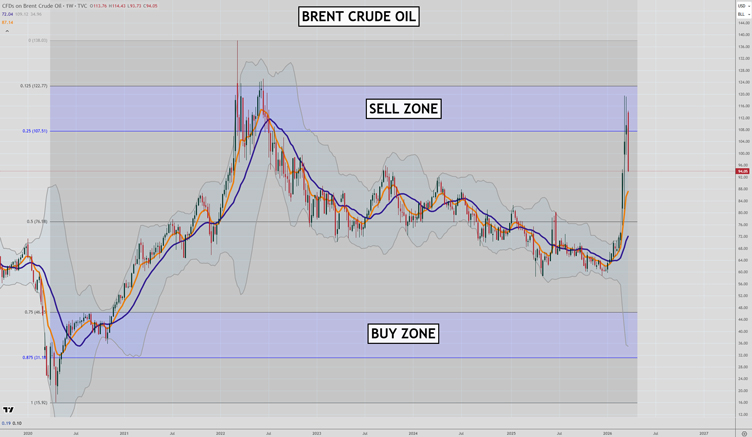
Source: TradingView
News that the US and Iran will meet on Thursday has the market excited that the war is coming to a close.
My guess is they both want an off-ramp before things get out of control.
The Strait of Hormuz has to be opened soon, or chaos will spread around the world.
Trump is backed into a corner, but he will claim a huge victory regardless.
The Iranians just want the regime to survive.
If Trump takes his bat and ball home now, everyone will get what they want, apart from Israel. They are shooting for regime change.
Markets are certainly oversold in the short-term, so a bounce looks on the cards.
Iran has said it will allow safe passage for non-combatant ships in the Strait. That has caused a steep fall in oil prices, with Brent crude dropping from US$100 to US$94 in the blink of an eye this morning.
S&P 500 futures have jumped nearly one per cent in the overnight markets, and the S&P/ASX 200 is up 178 points.
So, for now, it looks like risk-on until the next bit of bad news comes out.
Regards,

Murray Dawes,
Retirement Trader and International Stock Trader





Comments