


Last week, markets finally started to show signs of a ‘recovery rally.’
Two consecutive days of finishing in the green were the first sign of positive sentiment returning to the market since the crisis in the Middle East kicked off.
And that momentum is continuing today after President Trump posted on Truth Social that he would suspend attacks on Iran for two weeks.
But as I warned my paid readership group last week, we may not have experienced the final culminating bottom of this oil crisis yet.
How so?
Well, as you may know, I like to turn to the charts to get a sense of market momentum and where price action sits relative to support and resistance levels.
And as it stands, I believe we’re still on track to test a major level of support in the world’s benchmark index, the S&P500. Let me explain…
You might be familiar with the 100- and 200-daily moving averages for anticipating key support/resistance levels in markets.
In terms of the S&P500, both levels have been broken in this sell-off; short-term momentum remains negative.
But another indicator I shared with my premium membership group last week is still to be tested.
In my mind, it offers a much better measure of longer-term momentum.
It also happens to be the level at which several key markets hit their final lows in last year’s tariff fiasco, including the S&P 500.
But in fairness to my paid readership group, I won’t share the precise details, other than to say that 6,100 is the key level we’re watching for the S&P 500 right now.
Bottom line: the index will need to fall a further 7-8 per cent to reach this level. And if that happens, it will roil global markets back into a major panic.
It’s not a certainty, but it’s worth keeping on your radar as markets rejoice, despite the war still not having any end-date in sight.
But if you do have the contrarian mindset and believe that commodities remain a strong long-term theme, then it’s exactly the type of situation you should be looking to take advantage of.
What could drive a final
capitulation from here?
Here’s a snippet that I shared with my paid group last week from Anas Alhajji of the Daily Energy Report.
Alhajji is a renowned oil analyst who’s sceptical of the market’s premature celebration, given that the impacts haven’t yet been absorbed by global economies:
“A month into the Iran war, physical oil and fuel shortages are worsening globally, but crude benchmark prices remain relatively restrained because the market entered the crisis well supplied.
Emergency reserves have been released, and traders are still betting on a possible ceasefire. Meanwhile, real-world fuel markets are showing much greater stress, with products like jet fuel already at record highs.
FGE NexantECA says oil may reach $150-$200 a barrel if the crisis continues for another 6-8 weeks.”
Jet fuel is the canary in the coal mine for global fuel liquids.
Supply chains for this fuel type are designed for continuous tanker deliveries rather than long-term storage. That’s partly because jet fuel is difficult to store.
Airports hold ‘tank farms’; you’ve probably seen them as you drive past the airport. But these facilities can only hold a few weeks’ supply.
This is why jet fuel could be the first domino to fall if this crisis continues.
And in terms of Australia, we’re especially vulnerable.
That’s because Australia imported about 32% of its jet fuel from China last year. But on the back of this crisis, China has directed its oil refiners to halt ALL fuel exports.
And that leaves a major gap in Australia’s jet fuel supply chain:
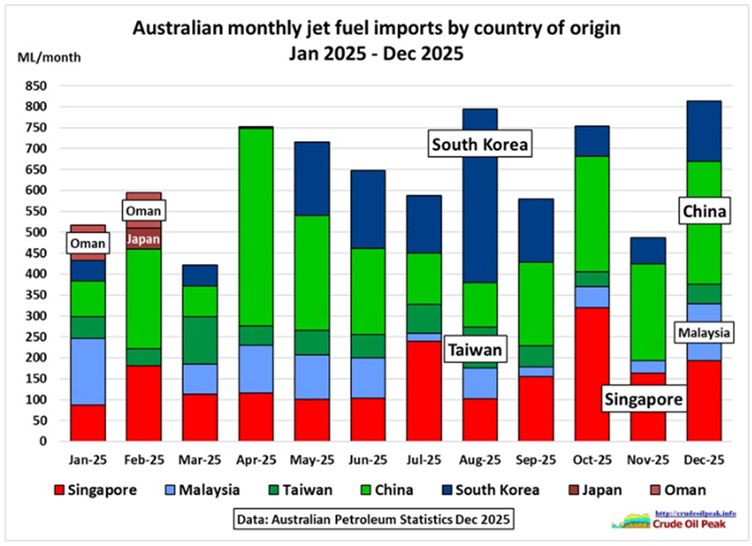
Source: Crude Oil Peak
[Click to open in a new window]
Bottom line: despite market optimism, risks remain for global economies, including here in Australia.
While that might sound somewhat worrying, as I told my paid readership group, it’s exactly the type of setup we’re targeting.
One final culminating low will see us take some profits on our oil and gas positions and redeploy them towards heavily sold-down miners.
Markets move quickly, so the time to start preparing is now.
If you’d like to join me and take full advantage of this potential move, you can do so here.
Until next time.
Regards,

James Cooper,
Mining: Phase One and Diggers and Drillers




Comments