



Nothing is more fabled and coveted than a 100-bagger stock.
The stock that returns 100 times the initial investment. The ‘generational wealth’ stock. The life-changer.
But these unicorns are rare.
They are rare because they’re invariably outstanding businesses with excellent track records.
Most businesses fail. And those that don’t, succumb to mediocrity as competition pushes returns lower.
And herein lies the 100-bagger’s secret.
In his popular book on 100-baggers, Christopher Mayer identified the ‘most important principle’ driving these stocks:
‘You need a business with a high return on capital with the ability to reinvest and earn that high return on capital for years and years.’
How can a business sustain a high return on capital for years and years?
Competitive advantage.
What is competitive advantage?
But what is competitive advantage, really?
A symptom of competitive advantage is sustained above-average returns on capital. Economics professor David Besanko lays it out this way in Economics of Strategy:
‘When a firm earns a higher rate of economic profit than the average rate of economic profit of other firms competing within the same market, the firm has a competitive advantage in that market. [Firms] achieve a competitive advantage by creating and delivering more economic value than their rivals and capture a portion of this value in the form of profits.’
|
|
| Source: Besanko et al., 2012 |

Two things stand out.
First, competitive strategy analysis isn’t just about the chosen stock under scrutiny.
It’s about the interaction of this stock with competitors. What is the business landscape of the industry and how are a company’s actions constrained and influenced by peers?
Second, competitive advantage is tied to profit. A company struggling to distinguish itself from rivals or add value beyond the industry standard won’t enjoy outsized profits — or profits at all.
Why is all this important?
Outsized long-term returns stem from outstanding business performance. And outstanding business performance is all about superior positioning to rivals.
Look at some of the most dominant and successful businesses in recent decades.
Apple, Microsoft, Google, Amazon.
|
|
| Source: Google Finance |
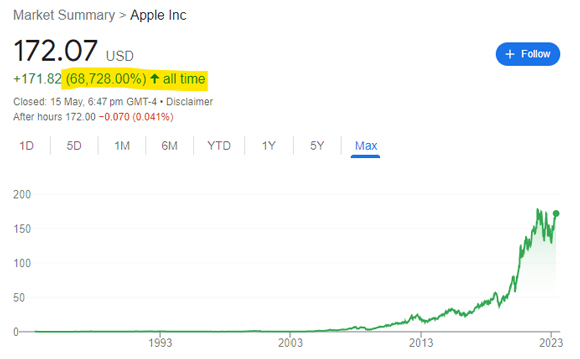
Each stock provided generational wealth to long-term holders. And each business is a leader in its industry.
Investors are often told they have to think like owners, that analysing businesses is more important than analysing securities.
That’s a helpful mind shift.
More specifically, investors must think deeply about competitive advantage. Author of Expectations Investing Michael Mauboussin even went so far as saying:
‘Competitive strategy analysis lies at the heart of security analysis.’
Market expectations and competitive advantage
Yet, thinking like a business owner is not sufficient.
Investors play a different game to entrepreneurs after all — a game with an added wrinkle: expectations.
Spotting an outstanding business may not be enough to secure high returns if other investors have spotted the business and priced its long-term potential accordingly.
Mauboussin makes a great point about this in Expectations Investing (emphasis added):
‘[Investors] generate superior returns when they correctly anticipate revisions in the market’s expectations for a company’s performance. Investors do not earn high rates of return on the stocks of the best value-creating companies if those stocks are priced to fully reflect that future performance. That is why great companies are not necessarily great stocks.’
This is really interesting.
Consider the earlier mentioned dominant businesses again: Apple, Microsoft, Google, and Amazon.
These are some of the best value-creating companies in history. But everyone knows this by now.
So are these mega-caps priced to perfection? Will their long-term returns pale in comparison to returns of yesteryear?
That will partly depend on how these companies adapt and continue to innovate — a big reason why these tech giants have endured.
Apple isn’t just selling iPhones these days. It sells watches, AirPods, and even streaming services.
Same goes for Google. It isn’t just a search engine anymore, but a conglomerate of products for the Internet age.
Artificial intelligence may be the great leveller, though.
If AI is the next big disrupting force in business, which companies will benefit most? What will competitive advantage in AI look like?
All great questions the market will be deliberating in the months ahead.
Barriers to entry — competitive advantage summed up
Competitive advantage may seem too abstract at times, a concept too academic for markets.
But there’s a great way to sum up competitive advantage: barriers to entry.
That’s what well-known business professor Bruce Greenwald did in his popular Competition Demystified.
There, Greenwald refined the concepts popularised by Michael Porter, who came to dominate strategic thinking by identifying five forces at work in strategy.
These five forces are substitutes, suppliers, potential entrants, buyers, and competitors.
Greenwald, however, thinks Porter’s taxonomy is not hierarchical enough.
For Greenwald, one force is ‘much more important than the others’. So much so that ‘leaders seeking to develop and pursue winning strategies should begin by ignoring the others and focus only on it’.
That force is barriers to entry. As Greenwald explained:
‘The existence of barriers to entry means that incumbent firms are able to do what potential rivals cannot. Being able to do what rivals cannot is the definition of a competitive advantage. Thus, barriers to entry and incumbent competitive advantages are simply two ways of describing the same thing. Entrant competitive advantages, on the other hand, have no value. By definition, a successful entrant becomes the incumbent. It then is vulnerable to the next entrant, who benefits from newer technology, less expensive labor, or some other temporary competitive edge. And because there are no barriers to entry, the cycle doesn’t stop. So it is only in the presence of incumbent competitive advantages that strategy, in our sense of the term, comes to the fore.’
Greenwald also sought to dispel the myth of differentiation.
It’s often assumed that competitive advantage lies with businesses selling a unique product or service.
But that is misleading. Companies with differentiated products may still suffer if rivals can easily enter the market.
For Greenwald, barriers to entry underpin all business strategy:
‘If no forces interfere with the process of entry by competitors, profitability will be driven to levels at which efficient firms earn no more than a “normal” return on their invested capital. It is barriers to entry, not differentiation by itself, that creates strategic opportunities.’
I hope this helps you assess stocks and their long-term outlook.
Regards,
Kiryll Prakapenka,
Editor, Money MorningPS: How are you finding Money Morning? We value your opinion, and would greatly appreciate your thoughts and feedback. Please take a moment to complete this short survey here.