


The Iranian strikes that broke out late last month have really turned the markets and economy upside down.
Just when the world started to settle down after the pandemic upended the supply chain and sent prices soaring, things are looking fragile again.
Precious metals investors would normally feel some relief as gold would bounce.
Except this time it hasn’t. Instead, gold pulled back and is now trying to hold the US$5,000 (~AU$7,050) an ounce line.
Military conflict driving war premium? Check.
Inflation accelerating and threatening the cost of living? Check.
So why isn’t gold taking off?
Yes, there is wall-to-wall coverage on the latest developments in Iran. We’ve watched footages of drone and missile strikes, buildings blown up, injuries and deaths, and leaders of the countries involved posturing about where they will take the conflict.
While most people are focusing on the Middle East tensions and oil spiking, something else is happening. What’s unfolding there plays a part in restraining gold’s rally in times of uncertainty.
I’m going to go back to basics to explain what’s going on.
The shift that impoverished the masses
The introduction of the Bretton-Woods system in 1944 shifted our monetary system from the Gold Standard to a petrodollar system. From there, we’ve priced everything in dollar terms, rather than in gold.
We’ve inverted the pricing basis now without knowing it. Worse still, it condemned ourselves to poverty.
How so?
Supply and demand determine prices. That’s basic economics.
Now consider this: what happens when you are pricing everything based on what’s falling in value?
Every currency – the US dollar, British pound, Euros, Chinese yuan, Japanese yen, Australian dollar, etc. has become less valuable over time.
Remember your grandparents telling you about how they could buy everything with a fraction of what we spend today? Things weren’t necessarily cheaper back then. There were fewer currencies floating around in the system. We just experienced massive inflation over the years to get to where we are.
Over the years, technology improved and global trade proliferated, boosting production, manufacturing, and consumption. They were the good times. We experienced a period where wealth improved for many.
However, the subprime crisis changed the trend. There was a limit to how much an economic system can rely on financialisation. The financial services sector had overused its power to create wealth, sucking up capital from Main Street to Wall Street.
What began with wealth creation using capital turned into a reliance on debt. Many borrowed to buy what they couldn’t afford, whether they are governments, businesses or households. These lenders created debt by leveraging their capital, effectively conjuring something out of nothing.
These lenders earned interest with little effort, creating more interest that bound capital to repaying loans rather than boosting productivity.
When productivity shifts from real assets to numbers on a ledger, that’s how society’s wealth begins to evaporate.
A rising US dollar for the wrong reasons
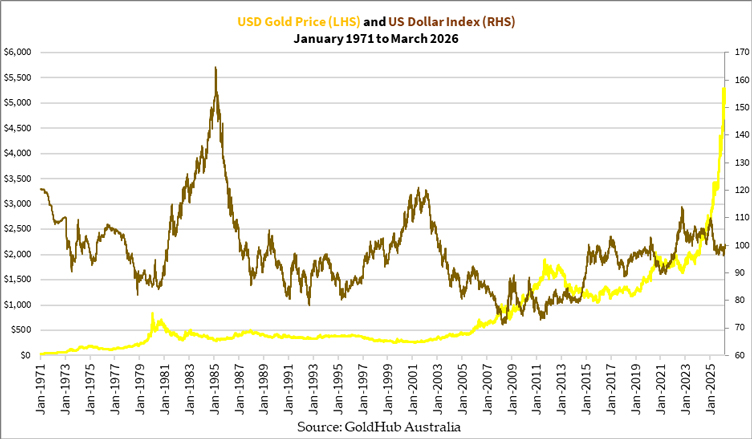
Over the long-term, gold and the US dollar have often moved in opposite directions, as you can see below:
[Click to open in a new window]
This dynamic stems from the current system pricing everything in dollar terms. We express gold in dollar terms too. The US dollar and gold act as money in this system, but compete with each other.
Gold’s moves depend on the relative supply and demand between it and the US dollar. Stable economic conditions could mean that people prefer the US dollar over gold. Business activity may create real wealth, allowing for the supply of the US dollar to remain stable. The Federal Reserve may raise the interest rate to reduce the supply of dollars to regulate the rate of growth and control inflation. Where this happens, the dollar could rise while gold falls. That’s because the relative supply of dollars is less than gold.
However, the reverse can happen in weak economic conditions. The Federal Reserve may boost the supply of dollars when the US government tries to boost business activity. A lower interest rate facilitates more borrowing, which creates more dollars into the system. These dollars flow into the economy, and may cause prices to rise across the economy – whether for goods and services, or financial assets. Gold would rise under such conditions as the supply of dollars increase.
It’s possible for both gold and the US dollar to rise together. However, this usually happens briefly as it reflects a period of acute distress, such as a financial crisis or major catastrophe. The increase in both the price of gold and the value of the US dollar comes from a flight to safety, when people sell other assets they hold for gold and the dollar. We saw this happen 1980 as inflation gripped the world after a decade of oil crises, in 2008-09 during the subprime crisis, 2020 as the world locked down, and briefly last year amidst the Israel-Iran conflict.
However, much of the last two years saw gold rise rapidly while the US dollar held up against other currencies. This happened on a smaller scale in 2019 when gold started surging after the Federal Reserve signalled it would begin to cut the interest rate. The scale of gold’s rally reflected the broad devaluation of fiat currencies, a belated response to the immense borrowing and spending from the pandemic and its aftermath.
Funds that once went into government-induced spending and into market speculation gradually flowed into gold. From central banks to individuals, they flocked to chase gold, turning it into a bubble as people queued up outside bullion stores.
The hidden crisis that is holding back gold
Amidst the buying frenzy of gold and precious metals from last October to early this February, something else was fomenting in the background to break this historic run. Besides the US and London exchanges imposing arbitrary rules to curb the purchase of precious metals contracts, the US private credit market was starting to crack.
Recently, Blue Owl Capital and BlackRock have suspended redemptions, while other credit funds from KKR, Ares, Blackstone, and Apollo posted substantial declines in their returns. As at the start of this week, the value of the decline in this market is around US$265 billion (~AU$370 billion). The crisis has apparently started to affect major investment banks including JP Morgan and Morgan Stanley.
Private credit largely comprises loans that conventional lenders would be reluctant to issue. They are more vulnerable to a weakening economy as their borrowers are lower quality.
Many borrowers were paying a lower interest rate when they applied for the loan before 2022. Now they risk defaulting on it because of higher interest rates since the recent rate hike cycle. As a result, lenders may end up writing down or even calling these loans bad debt if they can’t recover them.
The impact of a crisis building in this credit market is changing the dynamics of gold and the dollar.
How does a credit crisis strengthen the US dollar at gold’s expense?
Remember that pricing is in US dollars in our current system. Repaying or writing off loans reduce the supply of US dollars. Holding everything constant, the reduced dollar supply can cause deflation and push asset prices down. There are fewer dollars relative to other assets in the system.
While gold is supposed to rise with the Iranian conflict creating global uncertainty and fears of inflation, the unfolding debt situation in the US act as a counterbalance. Moreover, as the conflict drags on, fears of the Federal Reserve and other central banks raising rates to combat inflation further weigh down on gold.
In times like these, quoting theory and expecting a given outcome won’t be sufficient. There are too many moving parts. We must see the bigger picture and identify how they contribute to market dynamics.
There is much sensationalised reporting on what’s unfolding in the Middle East. However, remain level-headed and avoid doing what many are doing: reacting to the latest news and letting emotions drive their trades.
If you want guidance on how to manage your precious metals assets during such times, I’d invite you to consider signing up for The Australian Gold Report. I’ve recently published a book that explains the dynamics of the gold and silver assets market, how to value mining stocks, and manage your holdings through the ups and downs of a gold price cycle.
Check out my presentation here.
That’s it from me for this update. Enjoy the weekend ahead!
God Bless,

Brian Chu,
Gold Stock Pro and The Australian Gold Report




Comments