



It’s been a brutal few weeks for the small end of the ASX.
Resources stocks in particular have copped a hiding.
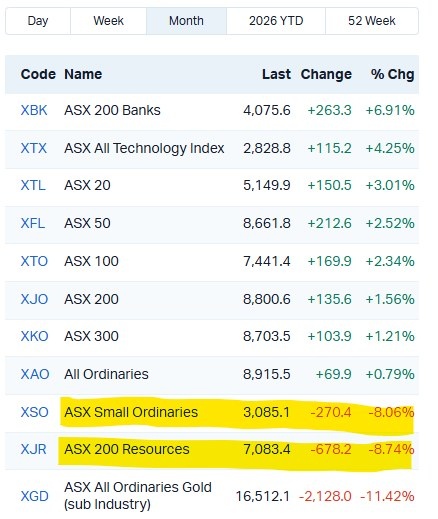
Here’s how the main ASX indices fared over the last month:
Source: Market Index
[Click to open in a new window]
The ASX 200 Resources index, home to giant miners like BHP and Rio Tinto, fell ~8.7%.
The Small Ordinaries, which tracks smaller companies and carries a heavy load of miners and explorers, dropped ~8.1%.
Gold miners fared worst, down ~11.4%. Meanwhile, the big banks climbed ~6.9%.
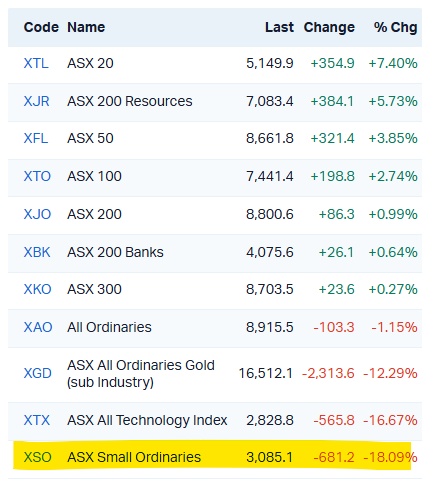
Zoom out further to the YTD performance and the small end looks even uglier:
Source: Market Index
[Click to open in a new window]
The Small Ordinaries is down 18.09% over that stretch, while the ASX 200 Resources index is still up 5.73%.
The big miners have held on, and the smaller end of town has borne the brunt.
Batting for a draw
There are a few reasons for this.
The biggest, in my view, is the market’s taste for defensive stocks.
These are large, established businesses with steady earnings that tend to hold up in good times and bad, like the big banks.
Not losing is the new winning, in so many words.
You can see why.
The RBA has lifted rates four times this year, and a fifth hike is a big possibility on Tuesday 3 November.
That decision lands about 30 minutes before the Melbourne Cup jumps.
It’s a chance to lose money twice in one afternoon.
Throw in a cooling gold price and the explorers’ quarterly cash reports landing this month, and you get a nasty set of market conditions for small resource stocks.
Those reports reveal who needs to raise money soon, usually at a discount to the share price.
The $70 billion bet against Australia
Then there are the short sellers.
Short selling is a way to profit from a falling share price.
A hedge fund borrows shares, sells them, then aims to buy them back cheaper and pocket the difference.
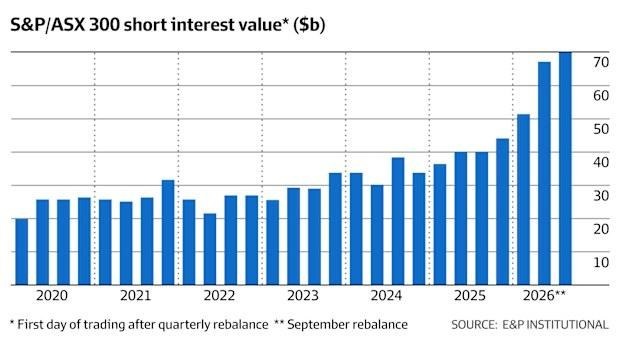
According to The Australian Financial Review, short positions across the ASX 300 are now worth just shy of $70 billion.
That’s up almost 74% in a year, and almost triple the level during the COVID panic in mid-2020.
Source: The Australian Financial Review
[Click to open in a new window]
A big slice of that, around $15 billion, is aimed at the big four banks.
That’s roughly three times the level at the start of the year.
Yet the banks rallied almost 7% last month.
Anyone betting against them would be nursing a loss.
The AFR also reports that offshore hedge funds use Australia as a funding market.
They buy shares in tightly regulated Asian markets and pay for those bets by shorting Aussie stocks, where the risk of a sudden shorting ban is negligible.
The short sellers are also creeping down the market.
One fund manager told the AFR that smaller ASX stocks are drawing more attention, since the big ones are priced more efficiently.
Light the fuse
Here’s why this matters for the smaller end of town.
Every short seller has to buy their borrowed shares back eventually.
If good news hits a heavily shorted stock, like a strong drill result, they all scramble to buy at once.
That’s called a short squeeze, and it can send a share price flying.
It works the other way too.
A weak cash report or a fifth rate hike hands short sellers more ammunition, and thinly traded small stocks can fall fast.
Between now and Christmas, the RBA meets twice, and ANZ, Westpac and NAB report results.
The short sellers betting against the banks will hang off every word.
So I expect the next two months to deliver genuine fireworks at the smaller end of the ASX, to the upside and the downside.
For investors backing well-funded small resource companies, a volatile stretch like this can sometimes present a chance to buy good businesses at lower prices.
Warm regards,
Dr. Lachlann Tierney,
Australian Small-Cap Investigator and Fat Tail Microcaps
PS: This was the year AI stopped answering and started acting. Agents that book, buy and even trade on your behalf. ATLAS 1.0 goes the other way: it does the watching and leaves every action to you. See how in the ATLAS 1.0 model showcase replay





Comments