

By now, you’ve probably heard the AI power story a hundred times. Data centres are devouring electricity. Grids are buckling. Nuclear is back in vogue.
Fair enough. Power is a real constraint. But it’s also a well-understood one. Governments, hyperscalers, utilities, and investors are all working on it.
The next bottleneck is less obvious — and arguably more urgent.
Nvidia just spent US$4 billion signalling what it is, and how it gets solved.
It’s not about generating more compute. It’s about moving the data between chips fast enough for the compute to matter.
The solution is photonics, the science of using light instead of electrons to carry information.
This is likely to be the next major infrastructure story for AI
A Networking Problem
When it comes to training or using a large AI model, it’s not a single-chip operation.
Training something like GPT-5 or Google’s Gemini means synchronising tens of thousands of GPUs.
Every chip must constantly share data with every other chip. That’s an enormous volume of internal traffic.
To give you some idea of the scale, Nvidia’s latest GPU connector (NVLink Spine) uses 2 miles of copper wire.
That system can transfer the entire internet’s peak traffic in less than a second.
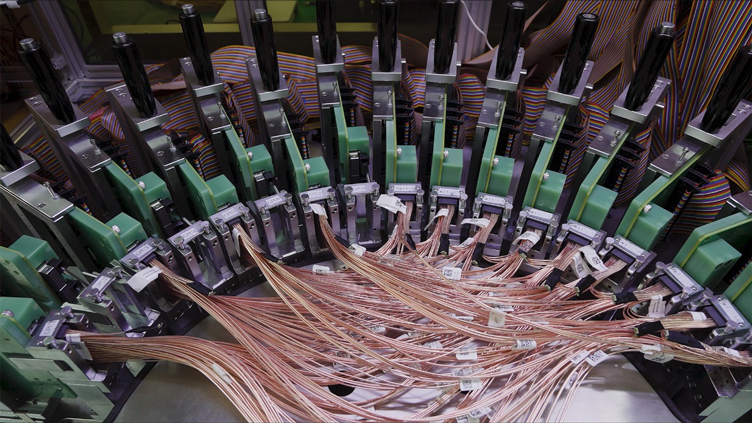
Source: Nvidia | NVLink Wire Testing
Soon, that’s not going to be enough. The wiring between chips is becoming just as important as the chips themselves.
If the links between those chips are slow, the GPUs sit idle waiting for data.
That’s already a problem on many sites running older hardware, and it will become an enormous one as data centres begin to network into larger clusters.
If you’ve spent billions on the world’s fastest processors and they’re twiddling their thumbs because the plumbing can’t keep up, there’s a problem.
Huge sums of power, water, and money are being wasted.
The core of the issue is that copper interconnects (between chips) are hitting a wall.
High-speed electrical signals lose integrity after just a few tens of centimetres, and at the frequencies modern AI systems demand, the power required to keep pushing electrons through copper becomes impractical.
More data through tighter copper at higher frequencies means more heat. And heat kills performance.
It degrades signals, warps materials, and forces engineers to spend more power on cooling than computing.
It’s not that copper stops working. It’s that the energy cost of making it work keeps climbing. Light doesn’t have these problems.
At the dotted yellow line below, you can see the scale at which optics versus copper is used.
You’re familiar with this tech through fibre optics, which connects our modern telco networks. That dotted line is now shifting to the right — into smaller domains.
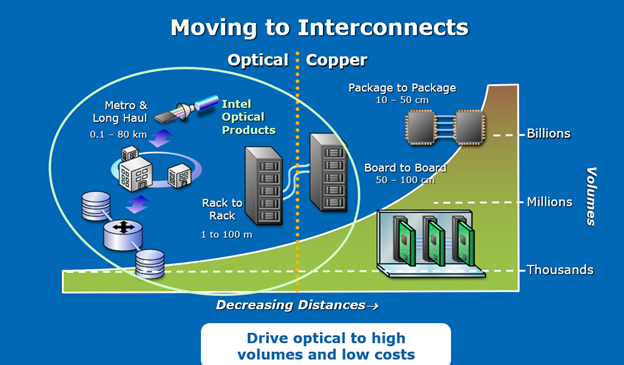
Source: Intel
A single strand of optical fibre can carry vastly more bandwidth than copper, over longer distances, with less heat and much lower power consumption.
This isn’t new technology; fibre likely already connects your home to the internet.
But what’s changing is where the light begins. The industry is pushing photonics from the edges of the data centre down to the chip level.

Source: Nvidia Blackwell Chip |Tom’s Hardware
This is the next big hardware shift in AI. But don’t take my word for it.
Follow the Money
When Nvidia drops US$4 billion into two photonics companies, it’s worth paying attention.
Earlier this month, the chipmaker invested US$2 billion each into Lumentum and Coherent.
These two US firms specialise in lasers and optical components used in data centre networking equipment.
Both deals include multi-billion-dollar purchase commitments and capacity rights for advanced laser components.
Lumentum is now building an entirely new fabrication facility on the back of it.
Jensen Huang framed it in his usual grandiose terms, talking about ‘gigawatt-scale AI factories.’
But strip away the marketing and the message is straightforward: Nvidia sees optical interconnects as a constraint on its own growth, and it’s locking in supply years in advance.
Nvidia isn’t alone.
Last week, Microsoft, Meta, OpenAI, AMD, Broadcom and Nvidia formed the Optical Compute Interconnect (OCI).
A boring name for what is essentially a homework-sharing group that will allow their future optics to work together in data centres.
This should simplify integration and speed up the buildout. But it’s just one of several major moves made recently.
Marvell also recently acquired a photonics startup, Celestial AI, for US$3.25 billion.
TSMC unveiled its COUPE platform for integrating photonic and electronic circuits on a single wafer.
Broadcom is also pushing in this direction, with the CEO in December saying:
‘I could see a point in time, in the future, when silicon photonics matters as the only way to do it. We’re not quite there yet, but we have the technology, and we continue to develop the technology.’
Inevitable doesn’t mean now.
Manufacturing is the first problem. Many photonic components rely on advanced materials like indium phosphide and gallium arsenide.
Raw material supply is tight. And packaging these components requires sub-micron alignment.
We’re talking about precision measured in fractions of a human hair.
That gap between ‘inevitable’ and ‘investable’ is where fortunes are made or lost.
The companies that solve the manufacturing and reliability problems will capture the lion’s share of the gains.
The Convergence Opportunity
There’s one more angle most investors haven’t connected yet.
The same photonic components being built for AI data centres — the lasers, the chip substrates, the precision packaging — are foundational to leading approaches to quantum computing.
Companies like PsiQuantum and Xanadu are building entire quantum architectures on photonic platforms. So investment in one accelerates the other.
A new quantum-AI convergence is taking shape right now.
The companies building the infrastructure that bridges both worlds could hand early investors an edge as these technologies scale from lab to production.
While the war with Iran continues, and everyone’s attention is focused there, Silicon Valley insider James Altucher has been tracking this convergence closely. He believes 2026 is the year it goes mainstream.
Some of the companies on his radar are still well off the beaten path for most Australian investors, even more so with war diverting everyone’s attention.
Click here to see James’s full presentation on the convergence opportunity.
Regards,

Charlie Ormond,
Small-Cap Systems and Altucher’s Investment Network Australia



Comments