

ASX News Live | ASX Flat; Appen Plummets, Lake Resources Signs Conditional Offtake
Is Appen nothing but a labour hire business?
If you operate in the tech space, are you necessarily a tech company?
By dent of your place in the sector, are you an agile, capital-light, and fast-growing firm?
For many years, Appen was considered as just that kind of tech stock — massive growth potential, capital light, proprietary technology leading to profitable scale.
But Appen has undergone a de-rating in recent years. APX shares are down over 90% since August 2020.
Has the market re-assessed what Appen is at its core?
Is Appen nothing more than a labour hire company?
A Rich Life‘s Claude Walker has been prescient about Appen’s long-term outlook given its core business model:
“One of the most popular ASX stocks over the last few years has been data labelling specialists Appen Ltd (ASX: APX). I first looked at Appen, and met its CEO, when it was trading at around $1.50. In hindsight, that would have been an excellent time to buy, but at the time I did not foresee the boom in demand for data labelling that was about to commence.
“You see, at that time, Appen looked to me like a labour hire firm. First, they would contract with a huge distributed workforce of casual data labellers, and then they would contract with large tech companies (principally Microsoft at that time) to use the contractor workforce to provide data labelling services. Appen’s profit was the difference between what they were paid by the tech companies, and what they paid the contractors.
“What I underestimated then was that in the period between 2015 and 2020, deep learning neural network artificial intelligence was taking off as a system. The upside of deep learning is that it is an extremely powerful way to train artificial intelligence, the downside is that it required tonnes more labelled data than prior versions of artificial intelligence.”
Owen Rask, co-founder of Rask Media, echoed Walker’s sentiment, arguing that Appen’s “technology is contracting human labour, an adjunct to ‘machine learning’ but not machine learning itself”.
Should the Fed slow down interest rate hikes?
The Reserve Bank of Australia surprised many when it jolted out of its 50 basis point interest rake hike groove.
Now some are arguing the US Federal Reserve should take heed and slow its pace accordingly before it breaks things.
But prominent US economist Jason Furman thinks arguments for the Fed easing off aren’t “fully compelling”.
“Those urging the Fed to slow down make four reasonable but uncompelling arguments. The first is that monetary policy works with long and variable lags. Let the medicine that has already been administered do its work before continuing to step up the dosage. One issue with this view is that two-thirds of the tightening, as measured by the Goldman Sachs financial conditions index, actually happened more than five months ago. A lot of tightening is already working, and it isn’t doing enough.
“More important, in the past three months the Fed’s preferred price index measure, core personal-consumption expenditures or PCE, has risen at a 5% annual rate. More troubling, this rate was held down by volatile technical factors like the large decline in the imputed price of investment advice, a component of the index even though no one actually pays it, that resulted from declining asset values. The more reliable median PCE price index grew at a 6.9% annual rate over that same time. Both of these are higher than where they were when Chairman Jerome Powell made his first pivot in November 2021.
“Inflation has persisted and strengthened even though many of the factors that were supposedly pushing it up have gotten better, including rapidly repairing supply chains, ample inventories, rising labor-force participation, falling energy prices, and an economy that is increasingly less affected by Covid.”
My latest @WSJopinion addresses four arguments that are being made by the growing chorus of people urging the Fed to slow down. All four arguments make a certain amount of sense but none are fully compelling.
This🧵summarizes and expands on the piece. https://t.co/yiRxm8xhBi pic.twitter.com/2roEmHgUPH
— Jason Furman (@jasonfurman) October 5, 2022
Appen down 14% on FY22 trading update
Appen has seen no improvement in trading conditions since its half-year result. This caught the stock by surprise as it thought its FY22 revenue would weigh to the latter half of FY22.
While Appen reiterated how occluded its revenue visibility is, the firm nonetheless provided “additional clarity for FY22 revenue and EBITDA”.
FY22 EBITDA and EBITDA margins are expected to remain “materially lower than FY21 and the most recent trading data reinforces this position.”
FY22 EBITDA is now expected to be in the range of US$13 million to US$18 million.
Broker RBC said the latest EBITDA downgrade is “material” at 51% below consensus estimates.
Appen pointed to external operating and macro conditions as the main culprits affecting performance:
“Challenging external operating and macro conditions have resulted in weaker digital advertising revenue and a slowdown in spending by some of our major customers. This has impacted our ad-related programs and had a flow on impact to non-ad related programs and some core programs.”
APX shares are now down 75% year to date, trading at around $2.85 a share.
APX shares were trading just over $40 a share in August 2020. Since then, the stock has fallen 92%.
Your front-row seat to the coming boom in critical metals
Australia is called the lucky country and for good reason…
The last mining boom was fuelled by enormous demand for iron, and it was Australia’s high-grade ore that commanded a premium over competitors.
I’m sure you’re well aware that the Pilbara gifted our country enormous wealth over those boom years.
With up to 75% iron content, these rocks were said to be of such a high grade that boil makers welded rocks to their steel-cap boots!
China had an insatiable appetite for our Pilbara ore.
As we knock on the door to the next mining boom, Australia sits in an enviable position (yet again).
But this time round, our competitive advantage will look much different.
China will still be an important part of the story but perhaps not in the way you would think.
A fundamental shift in Australian mining
It’s been a long time coming but Australian producers are finally value-adding their product by selling refined metal to the market directly, not raw ore, which was the default approach of the past.
Emerging operators are now regularly designing downstream processing facilities into their feasibility plans. It allows companies to reap a greater share of the gains from the product they extract.
But this change in strategy is not just about company profits.
https://www.dailyreckoning.com.au/part-two-your-front-row-seat-to-the-coming-boom-in-critical-metals/2022/10/06/
Polynovo up 10% on Q1 FY23 sales update
Polynovo (ASX:PNV) — a medical devices developer — is up over 10% at midday on Thursday after releasing a positive Q1 FY23 sales update.
Polynovo reported record first quarter sales and the first ever $5 million sales month.
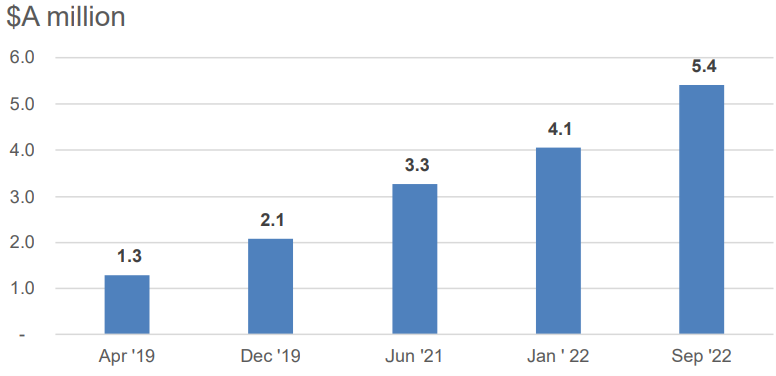
PNV’s September quarter sales rose 73% on same time last year to $12.5 million, including a record month in September, when sales totalled $5.4 million.
The $5.4 million notched in September means the other two months in the quarter averaged about $3.55 million per month.
Despite the record sales, PNV chairman David Williams admitted month to month sales “are still lumpy”.
In FY22, Polynovo’s total revenue rose 42.8% to $41.9 million and net loss after tax fell 74% to $1.2 million.
Bitcoin bides time for next big boom
In a week filled with more surprising central bank moves, markets have been gyrating wildly.
The RBA’s decision to ease back on rate hikes with only a 25-basis-point increase has certainly been the standout. That set the ASX off on a big 3.8% rebound rally for Tuesday — the biggest one-day surge in two years.
Does that mean we’ve passed the bottom of this bear market cycle, though?
Maybe…
Maybe not…
All anyone knows for certain is that we’re in unusual monetary territory. Inflation is still running relatively hot, but the data may be outdated after massive tightening from the world’s leading central banks.
The fact that the Bank of England recently had to pivot was a clear turning point — one that may influence other central banks for the remainder of 2022.
For weary investors who have endured a bitter year, though, the real question is where to look next.
Stocks still seem as volatile and unpredictable as ever. The only real winners have been commodities and energy.
Gold perhaps has a chance to prove its value as a hedge against further volatility.
And then there is the enigma that is Bitcoin [BTC]…
Everything but the price
Cryptocurrencies, and bitcoin, in particular, have had a rough year.
No one is going to deny that, and no one should be overly surprised by it.
Previous cycles in bitcoin have showcased just how volatile the swings from top to bottom can be. Each and every time, it’s been a similar story — a massive boom followed by a pretty deep bust.
But the crucial detail is that bitcoin always comes back stronger in the next cycle…
Every ‘crypto winter’ is followed by an incredible boom to new all-time highs.
The only real variable is how long the winter lasts. Because while each trough has been shorter than the last so far, no one knows for certain if this trend will continue.
However, what we can tell you is that some metrics, other than the price itself, are looking increasingly positive.
The hash rate for bitcoin, for example — a measure of the total computing power being used to power the network — just hit a new all-time high. At a peak of 321 exahashes per second, this means that miners are still flocking to the biggest cryptocurrency.
You can see the steady climb for yourself in the following chart:

Source: Coin Warz
Lake Resources up 6% on conditional offtake agreement
Lake Resources (ASX:LKE) is up 6% on Thursday after signing a conditional framework agreement (CFA) with WMC Energy for up to 25,000tpa of battery-grade lithium.
Under the CFA, WMC will acquire 10% of Lake at $1.20 per share to support the development of LKE’s Kachi Project in Argentina.
The offtake represents 50% of Kachi’s lithium production capacity on a ten-year initial term with an option to extend for a further five years.
The agreement is conditional. To become binding, the following conditions must eventuate:
-
“Successful DFS being released
-
“Lilac Demonstration Plant having successfully operated for a certain period of time, producing certain volumes
-
“Successful and satisfactory completion of due diligence by WMC Energy
-
“Formal agreements, regulatory approvals and ASX waiver”
What is interesting is the vague qualification of work associated with the Lilac Demonstration Plant. The plant must be operated for a certain period of time and produce certain volumes.
Neither the duration nor the volumes were quantified.
Stu Crow, Lake’s Executive Chairman, commented:
“The CFA delivers a long-term strategic alignment with WMC and its supply chain into its European and North American
customers. WMC Energy has a track record of being a market leader in nuclear fuels and expanded into battery materials including lithium to serve predominantly the US and European lithium-ion battery supply chain for EVs with their strategic needs.:”

Footer


Fat Tail Daily is brought to you by the team at Fat Tail Investment Research
Copyright © 2026 Fat Tail Daily | ACN: 117 765 009 / ABN: 33 117 765 009 / ASFL: 323 988