

ASX News Live | ASX Edges Higher; Megaport Sinks; Whitehaven, Beach Energy, BHP Feature
BHP: rising royalties by Queensland government a ‘serious threat to investment’
Mining giant BHP warned in its September quarterly report that the Queensland government’s near tripling of top end royalties “remains a serious concern and threat to investment and jobs in that state.”
BHP said it cannot make new investments in Queensland unless fiscal terms are “both competitive and predictable.”
A confronting chart leads to an opportunity
Check out this confronting chart:

Source: Bloomberg
You can see in the 2008 GFC bond value gains helped cushion equity market falls.
Not this time…
It’s a double whammy as both stocks and bonds take a pounding.
But it’s the bond valuation collapse that is most important to note.
As senior analyst Dylan LeClair noted, this is often the prelude to something big:
‘The last time the U.S. markets faced a drawdown of this magnitude, the U.S. Government defaulted upon its gold peg within the next 24 months.
‘1933 — Executive order 6102.
‘1971 — Nixon Shock.’
These events led to the eventual transition from gold-backed money to our current fiat system (dominated by the US dollar).
These current moves could set in motion a new transition.
Let me explain…
If #Bitcoin swallowed the entire US$100t #bond market, you’d be looking at around US$60m per $BTC!
Of course, that’s not going to happen.
But you can see the scope for $BTC to advance quite substantially from today’s price of just under US$20k. https://t.co/MvBX2OD5Tt
— Fat Tail Daily (@FatTailDaily) October 19, 2022
https://www.moneymorning.com.au/20221017/a-confronting-chart-leads-to-an-opportunity.html
Syrah and Novonix in trading halts following ‘material funding’ arrangements
Mozambique-based graphite producer Syrah Resources (ASX:SYR) entered a trading halt late on Wednesday citing a “material funding and commercial arrangement.”
Syrah expects to elaborate on this arrangement by Friday.
SYR’s trading halt citing a “material funding” arrangement echoes the reason cited by fellow battery tech stock Novonix (ASX:NVX), who also entered a trading halt today referencing a “material funding arrangement.”
Megaport down 19% on 1Q23 business update
Megaport reported its second consecutive quarterly EBITDA profit in 1Q23.
Megaport also changed its reporting currency to US dollars at the start of the quarter.
The financial highlights (in $US) for the September quarter:
- Revenue up 5% quarter-on-quarter to US$23 million
- Customers up 2% QoQ to 2,700
- Total ports up 1% QoQ to 9,606
- Total services up 3% QoQ to 28,326
- Receipts from customers up 14% QoQ to $25.7 million
- Cash at hand at quarter end of $44.9 million
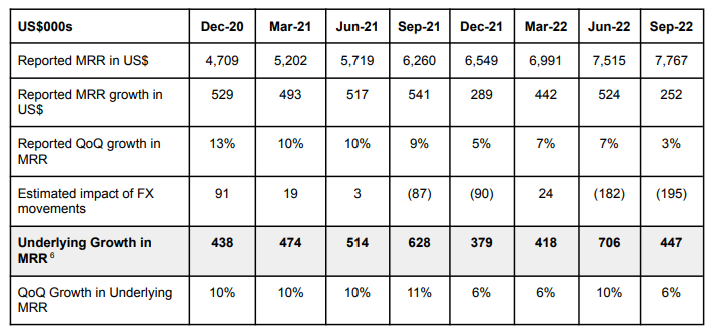
While Megaport reported its second consecutive quarterly EBITDA profit, the connectivity business ended the September quarter with negative free cash flow of about US$6.5 million.
Having started the quarter with US$56.9 million in cash and cash equivalents, Megaport saw that whittled down to US$44.9 by quarter’s end.
MP1 chief executive Vincent English commented on the September quarter result:
“With strong revenue fundamentals, and proven operating leverage built into our model, Megaport has delivered our second quarterly EBITDA profit consecutively. This is a significant team achievement as we continue to stay focused on our journey to profitability and cash generation. We have aligned our product suite with globally standardised port pricing and capacity. This has enabled a portion of our existing customer base with greater port capacity and positioned future customers with greater capacity the moment they join our platform.”
MP1 shares were down 19% at 3pm.
What does the plunging dollar mean for punters?
Last week, our Editorial Director Greg Canavan wrote to our paid subscribers in The Insider after a plunge in the Aussie dollar’s value. There is a myriad of effects that this creates for the Aussie economy, and it’s important that Aussie investors are aware of them — which is why we want to share this insight with you today. There are downsides to a lagging Aussie dollar, no doubt, but there are also benefits. If we plan accordingly, there’s a way to prepare our investments to be primed to rise when the bull market returns.
The Aussie dollar is a great barometer of global economic growth. When it’s as weak as it is now, that tells you something is wrong in global commerce.
That ‘something wrong’ is rising interest rates worldwide. As evidenced by the sharp fall in the Aussie dollar over the past few weeks, those rate rises are now starting to bite.
Monetary policy acts with a lag. And we don’t know how long that lag is. In his 1969 book The Optimum Quantity of Money, Milton Friedman said that monetary policy acts with ‘long and variable lags’.
He, therefore, argued for rule-based rather than discretionary monetary policy. Given the hole that central bankers have dug for us over the past few decades, it’s hard to argue that Friedman had it wrong.
Anyway, the point is the same one I’ve been making for a while now: The Fed continues to tighten while looking for evidence of its effect in lagging indicators.
The sharp decline in the Aussie dollar is just another example of the rapid slowdown in global growth occurring right under the Fed’s nose.
But it’s more than just that.
Flexible exchange rates mean currencies act as shock absorbers. What made the Great Depression so bad in the 1930s (aside from easy money in the lead up) was the rigidity of the currency system at the time.
Most major currencies were on a type of gold standard. So in the Great Depression, labour took a hit, as well as capital. The US dollar stood strong.
It was only in April 1933 that Roosevelt devalued the dollar against gold, nearly four years after the Depression began.
By that time, unemployment was around 25%, the banking system had collapsed, and the Dow Jones Index had already plunged 80% from top to bottom.
These days, currencies move relative to other currencies, so as not to inflict such harsh outcomes on labour and capital. Everyone is impacted in some way by currency movements. Some benefit, some lose. But the idea is that pain is spread in a broad manner rather than narrowly.
For example, a weaker Aussie dollar means imported goods cost more. It’s the market’s way of trying to discourage consumption and encourage production. But this can also feed into the inflation pressures Australia is already dealing with, putting pressure on the RBA to raise rates further.
On the other hand, the weaker dollar makes our exports cheaper in the eyes of foreign buyers. This is good for our food producers and other commodity exporters. But if they need to invest in imported plants and equipment to build new mines and/or production capacity, it increases the cost of this initial investment.
Another area that will likely benefit from a weaker Aussie dollar is high-end real estate. If you’re a cashed-up US investor and see that the Aussie dollar is down nearly 20% against the greenback in six months, a falling real estate market here all of a sudden looks very attractive.
https://www.dailyreckoning.com.au/what-the-plunging-aussie-dollar-means-for-you/2022/10/17/
How to profit from all stages of the mining cycle with Don Durrett
Author of How to Invest in Gold and Silver Don Durrett recently spoke with Fat Tail Investment Research’s Brian Chu in an extensive interview covering all things mining, gold, silver, and how to construct a strong portfolio of precious metal stocks.

Callum Newman: the bears can’t explain the iron ore price
All year we’ve heard about the crisis in energy and the acute effect it’s having on Europe.
But you wouldn’t know it walking around Spain, which is what I’ve just done for the last month.
And the war in Ukraine? That felt as distant to daily life there as it does here.
That’s not to say the issues aren’t real…only that, whatever happens, the world keeps turning.
One wonders, too, how much of this energy issue is built into prices.
If not 100%, it must be mighty close.
I’m back in Australia now.
For this reason, I’m turning my eyes north to China today. All the news is about the latest Communist Party shindig.
But here’s what I’m thinking about…
Have you noticed that the price of iron ore is still at more than US$95 a tonne?
That sticks out like the proverbial to me.
Here’s why…
For more than 12 months, Chinese property developers have been struck in a liquidity and solvency crisis as they deal with a stalled property market, defaulting loan payments, and protesting buyers.
All we ever hear about in Australia is how iron ore goes into steel, and most steel is used in Chinese construction, especially property.
Why, then, does iron ore remain so resilient?
Now, a cynic might say that it’s down from the giddy heights of US$200 a tonne it hit last year…
But here’s a table I put together last year of the average iron ore price back to 2015:

Today’s price is still a boomer, relatively speaking.
And again, consider the context that Chinese growth continually gets written down from COVID lockdowns, weak property sales, and the general global dog’s breakfast going on right now.
Something doesn’t quite square here. Either China’s growth is better than presumed, or iron ore is less available than presupposed.
Or perhaps China is stockpiling it, regardless of the fundamental economics of the market.
I can’t tell you what the answer is.
What I can say is that the current price continues to pour huge revenue through Australian miners and the Australian Government.
You need to follow the market a bit to see the significance of this price, too, in a different way.
https://www.moneymorning.com.au/20221019/the-stock-bears-cant-explain-the-iron-ore-price.html
Choose your own adventure: the recession edition
Growing up, I was a big fan of the Choose Your Own Adventure stories.
A few years back, Netflix even produced its own version of an interactive TV show. You may have seen the likes of Black Mirror: Bandersnatch.
In these stories, you, the reader, are the main character and in charge of what happens.
The books start by introducing a storyline that moves you along until you reach a crossroads. You then need to make a choice to keep on reading (or watching the TV show).
Your choices will have different consequences.
A ‘right’ one will bring you closer to your goal.
A ‘wrong’ one will likely bring setbacks and more challenges. What’s worse, it could even lead to premature death.
Much of what I liked about the books was that there is no clear right or wrong choice. Any decision you make could have very unpredictable consequences.
This is mainly because you don’t get all the facts until after you’ve made your decision. So, you need to make what you think is the best choice for the situation with the limited amount of information you have.
Much like in life and investing, you try to interpret the world around you and make decisions without having the whole picture.
All year economists and investors are trying to determine the likelihood of a recession and how to position themselves.
Central banks are raising rates and tightening balance sheets in a bid to fight inflation. It’s the reverse of what had been happening for years.
It’s scaring markets and pushing down house prices.
Add to that an energy crisis, a pandemic, a war, and geopolitical tensions…there’s no denying things are looking very dangerous out there.
https://www.moneymorning.com.au/20221019/adventures-in-an-uncertain-economy.html
Whitehaven bounces back from early trade fall
Whitehaven Coal shares opened over 5% lower at market open but have since recovered, trading flat at 11am.
While the coal producer saw production and sales volumes slump in the September quarter due to rain and flooding disrupting its open cut operations, WHC said it’s “on track to deliver within the range of our overall production, sales and cost guidance for FY23.”
Whitehaven said it has ways to circumvent the effects of adverse weather, especially associated with La Nina.
Some of the strategies will involve transporting staff via helicopter when roads are closed and contracting extra haulage capacity when haulage roads are open.
Whitehaven: metallurgical coal market ‘significantly weakened’
While CV thermal coal set fresh record highs in the September quarter, metallurgical coal prices waned.
Whitehaven said the market for metallurgical coal “significantly weakened in the September quarter as steel demand dropped on a significant slowdown in China due to strict COVID lockdowns, India’s tariffs on steel exports and overall softened demand for steel products.”
The divergence between thermal coal and metallurgical coal has incentivised the sale of the former, said Whitehaven.
WHC expects “further volatility” in metallurgical coal markets as global economic pressures persist.
Whitehaven: September quarter saw consecutive monthly record high coal prices
In its latest quarterly, Whitehaven Coal noted that the September quarter was marked by three consecutive record highs for the monthly gC NEWC Index.
The GlobalCoal NEWC Index is the benchmark price for seaborne thermal coal in the Asia-Pacific and is the main price reference for physical coal contracts in the region.
The quarter started with coal prices of US$411/t in July, US$417/t in August, and US$434/t in September.
Whitehaven noted:
“Energy security was a continued focus during the quarter with continued strong demand, supply constraints and high prices for high quality thermal coal. The impact of sanctions and embargoes on Russian coal is resulting in a high CV thermal coal trade flow response, where countries that typically do not take large volumes of high CV thermal coal are now moving to take advantage of cheaper Russian coal.”
Whitehaven Coal falls 5%, production down 37%
While Whitehaven reported ‘record coal prices’ during Q1 FY23, the coal producer also admitted that weather has affected its open cut operations and volumes.
Whitehaven said it achieved a record average coal price of $581/t for the quarter, higher than the $514/t in the June quarter and higher still than the $189/t achieved in the prior corresponding period.
However, managed run-of-mine production of 4Mt was down 37% on the June quarter and down 22% on the prior corresponding period.
Total equity sales of produced coal also fell, down 32% on the June quarter and 14% on the prior corresponding period.
WHC chief executive Paul Flynn stated:
“With demand for high quality coal continuing to outstrip global supply, coal prices set another record in the September quarter and continue to be well supported. We delivered strong operational performance in the September quarter at our Narrabri underground mine but our open cut operations were impacted by wet weather and flood related road closures in September. With La Niña forecast to be a feature through the Spring season, we have been working constructively with councils and developing measures to minimise the impacts of weather delays and flood related road closures as much as possible.”
Whitehaven already expected all its open cut mine operations to produce lower volumes in the quarter due to mine sequencing.
But production volumes were even lower than the coal producer anticipated as a result of rain disruption and flooding in September.
WHC shares opened up 5% lower on Wednesday.

Footer


Fat Tail Daily is brought to you by the team at Fat Tail Investment Research
Copyright © 2026 Fat Tail Daily | ACN: 117 765 009 / ABN: 33 117 765 009 / ASFL: 323 988