

ASX LIVE | ASX to Rise, RBNZ Decision Day, Oil Climbs, KMD Brand Hit $1.1b Sales
Thats all from me today
Have a great evening, investors.
Watch out for those CPI numbers from the US to paint a picture for tomorrow’s trading.
Here’s today’s Bing AI-generated image!

ASX close update
ASX 200 closed up 0.38% today, continuing another positive day in the markets as investors remain hopeful about overnight CPI data out of the US.
All figures shown are from 4:40pm AEST
- $AUD up +0.45% at 67.15 US cents
- ASX futures up +0.50% to 7,096.5
- S&P 500 up +0.67%
- NASDAQ up +0.93%
- DOW up +0.62%
- FTSE up +0.12%
- STOXX up +0.44%
- SSE down -0.75%
- Bitcoin up +0.57% to $US 30,751
- Spot gold up +0.16% to $US 1,936.44
- Iron ore up 0.012% to $US 109.34
- Brent Crude up +0.06% to $US 79.45pb
ASX 200 Sector Top Performance
- Energy up 1.96%
- Materials up +1.00%
- Industrials up +0.38%
The best individual performers:
- Capricorn Metals [ASX:CMM], up 8.01%
- De Grey Mining [ASX:DEG], up 6.16%
- Sandfire Resources [ASX:SFR], up 4.91%
- Core Lithium [ASX:CXO], up 4.89%
- Perseus Mining [ASX:PRU], up 4.31%
The worst performers:
- Contact Energy [ASX:CEN], down 4.09%
- Chalice Mining [ASX:CHN], down 2.82%
- Sayona Mining [ASX:SYA], down 2.63%
- Infratil [ASX:IFT], down 2.36%
- Pilbara Minerals [ASX:PLS], down 2.19%
US Producer price inflation down signalling positive signs for US
As markets await US CPI data overnight let’s look at early signs from Producer inflation, signalling potential falling CPI data to come.
Producer price inflation fell again in June to 4.1%yoy.
(Goldman Sachs chart) pic.twitter.com/OQIPYrXjb7— Shane Oliver (@ShaneOliverAMP) July 12, 2023
Oil nears $80 per barrel
Brent oil stabilized after a 2% increase yesterday, driven by signs of declining Russian crude production.
The market hovered just shy of $80 a barrel, last breached in May, while vessel tracking data showed significant drops in shipments through Russian ports.
A weaker dollar supported commodities as investors awaited the US consumer price index for clues on the Fed’s future monetary tightening.
Despite lower oil prices this year, Saudi Arabia and Russia’s supply cuts aim to tighten the global market and draw down stockpiles. Market analysts believe that surpassing the key $80 level could lead to retesting the year’s high of $89.
Traders eagerly anticipate the release of the Energy Information Administration’s US crude stockpiles report and monthly reports from the International Energy Agency and OPEC. These reports will provide insights into supply levels and global oil market conditions, shaping the near-term outlook.
Phillip Lowe’s remarks after speech
During questions after his speech, a Bloomberg reporter asked Mr Lowe whether he is more confident now that interest rate increases are having an impact, compared to two months ago.
He remarked:
‘I am confident that higher interest rates are working. Talk to any retailer at the moment they will say I’m spending slowly, and people trading down to cheaper items and in some cases small baskets.’
‘Consumption growth is weak and that is largely because of what is going on with monetary policy but also the declining incomes from higher inflation [shows] policy is working, the issue is do we have to do more?‘
‘And as I said in my remarks that is to be determined and will be determined by our assessment of the inflation risks and outlook on what is going on with spending.‘
‘We’re confident what we’re doing working, the question mark is what do we need to do and we have a completely open mind on that question.’
In a long question surrounding the nature of global central banks and their aggressive hikes, Mr Lowe was asked if we could expect the same aggressive hiking in Australia in the future.
He replied:
‘Most of the central banks have higher interest rates than we have, so it is a good question about why we haven’t raised rates even further.’
‘There are a number of factors. The first is that normal wages growth in Australia is still lower than it is in most other advanced economies. The aggregate level, wages are growing between 3.5 and 4%.’
‘In the US, Canada, the UK and about 5%, in some cases above 6%. It is quite a difference.’
‘A second, and this is related, that supply in Australia is a lot more flexible than other countries, our participation rate here is setting record highs every month. So the domestic population, more and more have entered the labour force and the supply side of labour is much more flexible than in the US where the participation rate still hasn’t got back to its previous peak.’
‘So they are two reasons why the underlying inflation pressures in Australia are less than they are in some countries, and it is really important that that remains the case.’
‘If we saw Australia in the same situation as in the US, Canada, UK, where wages were growing at 6%, that would have implications for our setting of monetary policy. The other element is we have been prepared to allow inflation to come back to target a bit more slowly and some other central banks.’
In a big change in tone, Lowe said the RBA is trying to preserve the labour market:
‘We have been prepared to go a bit slower to try and preserve those gains in the labour market that we have got over the last two years.’
‘It took us nearly 50 years to get back to full employment. We are probably through that, but youth unemployment is the lowest it has been in decades, people have been able to get jobs, so there is a huge economic and social benefit.’
‘So we took the decision to go a bit more slowly back to the target than some other central banks to try and preserve that, and I still hope we can manage it.
It looks like the RBA has done some soul-searching and has decided that telling the Australian people that it wants unemployment (while congruent with modern monetary policy) is terrible for optics.
Phillip Lowe discusses RBA changes ‘as times changes we need to change too’
Here are the highlights of Phillip Lowes’s speech today at The Economic Society of Australia in Queensland.
In the speech, he discussed future changes at the RBA, which he said were supported by the board and bank staff, as he remarked, ‘As times change, we need to change too‘.
First were his ten points of change to the RBA after the recommendations laid out by the review:
- From next year the board will only meet eight times a year, down from eleven times a year. Four of those meetings will be held on the first Tuesday of February, May, August and November, with the other four held midway between those.
- The meetings will be longer, stretching out over two days rather than its current one.
- All board members will have the opportunity of an internal staff meeting before the RBA decision day to discuss and question staff.
- The post-meeting statement will be issued under the name of the board rather than the governor (I think he’s sore after catching the ire of many Australians from previous rate hikes)
- The governor will hold a media conference after the future rate announcements, explaining the decision.
- The quarterly statement on monetary policy will be released at the same time as the decision by the board rather than the following Friday.
- The board, rather than the governor, will be the signatory to the RBA conduct and policy.
- The board will oversee the bank’s research agenda.
- The bank will continue to incorporate climate change data into the analysis of the economy.
- The board will work with the Treasury to undertake five-yearly open reviews of the monetary policy framework.
Other changes were highlighted by Mr Lowe but said they would not be implemented, as they are ‘best considered after a legislative process has been completed‘ and a new board had been established. These were:
- The publication of an unattributed vote count.
- All board members make regular public appearances to discuss their thinking on policy matters.
- The establishment of an external expert advisory group to encourage diversity of thought.
- Board papers being published with a five-year lag.
Some interesting changes here; an obvious push for transparency in some changes to avoid big surprise rate shifts, which have caused pain recently and the souring of public perception.
Interestingly a shift away from the responsibility of the RBA governor to a more collective decision could be in response to the low public approval ratings seen recently.
There were also clear signals of attempts to shift decisions out of the Ivory Tower bubble, with increased policy reviews and engagement outside of the RBA.
AustraliaEU trade negotiations fail to make headway
Australia and the European Union have been unable to reach a resolution on their long-standing free trade agreement negotiations, which are valued at nearly $100 billion.
Australia’s Trade Minister, Don Farrell, travelled to Brussels this week to break the deadlock but was unsuccessful.
The EU has sought to limit Australia’s use of names like prosecco, mozzarella, parmesan, and feta, insisting that these names be reserved for products originating from specific regions.
While Australia wants increased market access for exports such as beef, lamb, and dairy and argues that Europeans immigrated to Australia and should be able to continue using the names.
After two days of negotiations failed to break the deadlock, both parties will reconvene next month to continue the discussions.
Australian producers fear naming rights to hundreds of products may be at risk if a deal is secured.
Despite the disappointment, Senator Farrell emphasized that Australia will hold its ground, saying:
‘We’ve made it very clear right from the start that we won’t simply accept any agreement.‘
‘The agreement, from the Australian point of view, has to achieve meaningful agricultural access to European markets, and that’s what we’re continuing to pursue in these negotiations‘
NFF chief executive Tony Mahar applauded Senator Farrell and the negotiating team for ‘rejecting a sub-standard deal‘.
‘We’re hopeful that with some grit and goodwill from both sides we can get this thing done in a way that benefits everyone, including Aussie farmers,’ Mr Mahar said.
The EU has higher tariffs than Australia on many industrial goods, with exports facing tariffs of up to 12% on minerals and metals, 10% on wood and paper and 7%on chemicals.
Australia will seek the elimination of all EU tariffs on industrial goods, providing a competitive advantage to Australian goods exporters.In exchange for receiving improved market access into the EU, Australia will make similar cuts on tariffs on imports from the EU, reducing the price of goods for consumers.
While an agreement has not been reached, both sides say they remain committed to further negotiations.
Treasury decision on new RBA head looms
With Phillip Lowe about to step up to the podium to make what could possibly be one of his last speeches as governor of the RBA. Let’s look at who’s on the shortlist.
Australian Treasurer Jim Chalmers said he expects to discuss with the Cabinet soon on whether RBA Governor Philip Lowe will receive an extension to his term https://t.co/B3aUTLdmBS
— Bloomberg Economics (@economics) July 12, 2023
Big Four banks face grilling in front of Economic Committe
The CEOs of Australia’s Big Four, ANZ, Commonwealth Bank, National Australia Bank, and Westpac, will appear before the House Standing Committee on Economics in Canberra today and tomorrow.
Dr. Daniel Mulino MP, the Committee Chair, expressed the significance of these public hearings:
‘These public hearings are a timely opportunity to once again put a spotlight on the Big Four,’ Committee Chair, Dr Daniel Mulino MP, said. ‘Australian households and small businesses depend on these banks for general banking, mortgages, and business loans. It is crucial that our banks are resilient, but also competitive, given that the Big Four banks control some 80% of the market‘.
The committee aims to scrutinise the measures taken by these banks to safeguard their institutions and customers, particularly in light of rising interest rates, bank closures, and rising scams.
‘…in a year that has been characterised by rising interest rates, bank closures, and increasingly sophisticated scams, the committee will examine the measures the banks have taken to protect their institutions and their customers,’ Dr Mulino said.
Over two days, the public hearings will address these topics as part of the committee’s ongoing review of Australia’s major banks and its inquiry into promoting economic dynamism, competition, and business formation.
Dr. Mulino emphasised that the inquiry into competition would cover various related issues, including market concentration and barriers to entry.
It remains to be seen if the committee actually has any teeth to make significant changes in the highly concentrated sector.
Aus Bank Concentration
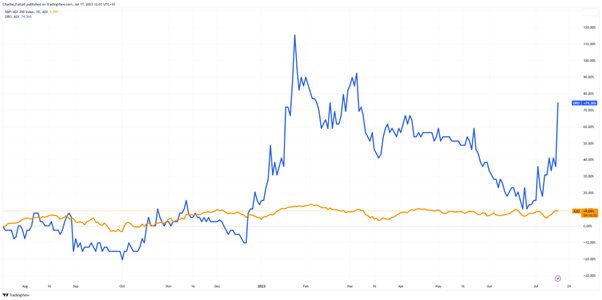
Source: TradingEconomics
RBNZ keeps rate on pause at 5.5%
In a second consecutive meeting, the Reserve Bank of New Zealand (RBNZ) has chosen to keep interest rates unchanged at 5.5%. This decision follows the previous rate hike in May from 5.25%.
The RBNZ outlined the rationale in a policy statement:
‘The Monetary Policy Committee today agreed to leave the Official Cash Rate (OCR) at 5.5 per cent.
The level of interest rates are constraining spending and inflation pressure as anticipated and required. The Committee agreed that the OCR will need to remain at a restrictive level for the foreseeable future, to ensure that consumer price inflation returns to the 1 to 3 per cent annual target range, while supporting maximum sustainable employment.
Global economic growth remains weak and inflation pressures are easing. This follows a period of significant monetary policy tightening by central banks internationally. Global inflation rates continue to decline, assisted by the normalisation of international supply chains, and the decline in shipping costs and energy prices. The weaker global growth has led to lower export prices for New Zealand’s goods.
In New Zealand, inflation is expected to continue to decline from its peak, and with it measures of inflation expectations. Core inflation is expected to decline as capacity constraints ease. While employment is above its maximum sustainable level, there are signs of labour market pressures dissipating and vacancies declining.
Consumer spending growth has eased and residential construction activity has declined, while house prices have returned to more sustainable levels. More generally, businesses are reporting slower demand for their goods and services, and weak investment intentions.
The return of net inward migration continues broadly as anticipated, and is assisting to ease labour shortages. The net impact of immigration on overall capacity pressures remains uncertain. The ongoing recovery in tourism spending is supporting demand.
The repair and rebuild underway in regions of the North Island due to severe weather events will support economic activity in the near term. Broader government spending is anticipated to decline in inflation-adjusted terms and in proportion to GDP.
The Committee is confident that with interest rates remaining at a restrictive level for some time, consumer price inflation will return to within its target range of 1 to 3% per annum, while supporting maximum sustainable employment.’
Midday market update
ASX 200 is up 0.47% at 7,142.6
The best individual performers:
- Stanmore Resources [ASX:SMR], up 5.10%
- Incitec Pivot [ASX:IPL], up 4.15%
- Block Inc [ASX:SQ2], up 2.72%
- Virgin Money UK [ASX:VUK], up 2.70%
- Capricorn Metals [ASX:CMM], up 2.39%
The worst performers:
- Sayona Mining [ASX:SYA], down 2.63%
- Meridian Energy [ASX:MEZ], down 2.30%
- Gold Road Resources [ASX:GOR], down 1.89%
- Zimplats Holdings [ASX:ZIM], down 1.77%
- Corporate Travel Management [ASX:CTD], down 1.70%
All figures shown are from 12:00pm AEST
S&P 500 Companies Reach New High in Positive EPS Guidance Since Q3 2021
Looks like no one can rain on Wall Street’s parade, as early profit guidance has come through, showing S&P 500 companies are painting a rosy picture for future earnings.
In a remarkable turn of events, the second quarter has witnessed an unprecedented surge in the number of S&P 500 companies issuing positive EPS guidance, reaching levels not seen since Q3 2021.
As of today, out of the 113 S&P 500 companies that have provided EPS guidance for the second quarter, 46 companies have issued positive guidance, surpassing both the 5-year average of 40 and the 10-year average of 35.
While the number of companies providing negative EPS guidance stands at 67, which aligns with figures from three of the past four quarters, the rise in companies delivering positive guidance is pretty incredible considering sentiment. This surge indicates renewed optimism and confidence among these companies in their earnings prospects for the second quarter.
Unsurprisingly to those watching markets, the Information Technology and Industrials sectors emerge as leaders in positive EPS guidance issuance, with 20 and 9 companies, respectively, providing optimistic projections for the second quarter. Together, these two sectors account for more than half of all S&P 500 companies issuing positive EPS guidance, totalling 29 out of 46.
Interestingly, despite the surge in positive EPS guidance issuances compared to recent quarters, the percentage of S&P 500 companies providing positive guidance remains consistent with the 5-year average.
Out of the 113 companies offering EPS guidance for Q2 2023, 46, or 41%, are projecting positive earnings, aligning with the 5-year average. This figure does exceed the 10-year average of 36% however, reflecting an overall positive sentiment among the companies in the index.

Source: FactSet
Morning market update
ASX 200 looks to climb today along with Wall St after hints at positive signs from CPI numbers out of the US later today.
ASX closed up 1.50% yesterday, the best day of trading in six months.
- $AUD up +0.10% at 66.92 US cents
- ASX futures up +1.91% to 7,096.0
- S&P 500 up +0.67%
- NASDAQ up +0.55%
- DOW up +0.93%
- FTSE up +0.12%
- STOXX up +0.44%
- SSE up +0.55%
- Bitcoin up +0.74% to $US 30,607
- Spot gold up +0.44% to $US 1,933.29
- Iron ore down -1.20% to $US 109.21
- Brent Crude up +0.06% to $US 79.35pb
All figures shown are from 9:30 am AEST
Good morning investors!
Good morning all Kiryll here with you today covering all the biggest news in the markets around the world.
Expectations of a positive day trading may find a potential bump if unexpected news comes out of either Australasian central bank chief’s speeches today.
RBNZ is expected to announce its official cash rate decision around 12:00pm AEST.
The expectation in the markets is the RBNZ will keep rates on hold at 5.50%.
Phillip Lowe is expected to speak today at 1.10pm AEST. With his job on the line and Treasury head, Jim Chalmers set to announce the new RBA governor soon, this could be an important one for Lowe. He has faced criticism due to his statements during the pandemic suggesting that interest rates were unlikely to increase before 2024.
Included among the candidates who are in the running for the RBA head job are:
- Michele Bullock, the Deputy Governor of RBA
- Jenny Wilkinson, the Secretary of Finance
- Steven Kennedy, the Secretary of the Treasury
Here’s Bing AI Image generator’s attempt to interpret the news.


Footer


Fat Tail Daily is brought to you by the team at Fat Tail Investment Research
Copyright © 2026 Fat Tail Daily | ACN: 117 765 009 / ABN: 33 117 765 009 / ASFL: 323 988