



I remember my childhood days shopping at department stores in the 1990s in Australia. There were Grace Brothers (now Myer) and David Jones. David Jones brings back some fond memories. I can still remember watching a Mother’s Day advertisement on TV featuring a Dalmatian mother and her cute little puppy. Those wanting to relive the memory can watch it here:

David Jones stood out for its elegance and style, and the range of products for sale and prices. The David Jones staff was refined in both dress and manner. It was the iconic Australian store for the middle and upper-middle class.
You felt like a special guest by the way they addressed and served you. I even slowed myself to a stately pace when I was in the store, which is noteworthy given I was in my primary and high school years.
Our family didn’t shop at David Jones too often. We may go there to buy gifts for others or spend the gift vouchers that relatives and friends gave us. Otherwise, we might buy our goods and homewares from more downmarket stores.
This may be the mindset for many Australian households, and even more so today as the economy spirals downwards. The likes of David Jones and Myer are competing against discount variety stores such as Big W, Kmart, TK Maxx, etc. Or they’d go online to buy from Amazon, Kogan, Temu or specialist retailers.
With David Jones recently entering voluntary administration, many Australians are saddened by its decline. Even if this isn’t their preferred department store, this news cuts at the heart of the country. Moreover, it reflects the state of Australia’s middle class.
Golden years lost… temporary or for good?
Let’s cast our minds back to the 1980s and 1990s for a while. Many look back at those times with nostalgia, especially because it was a period when Australia, and much of the Western world, was in its golden years. Household income was such that many could choose whether to have one or two at work. Mortgage rates were much higher than that today, but household debt was significantly less. Therefore, people had enough to set aside for some of the nicer things in life.
During the 2026 Australian Gold Conference, a faithful Fat Tailer, Keith Payne, approached me to introduce himself and we had a good chat. He particularly wanted to share with me how he was one of a lucky few who had paid off his home in the early 1980s. Not only that, he shared with me how he had built a business and secured his family financially.
Besides that, Keith shared his heartfelt concerns about our country. He observed with disappointment the decades of government policy errors and economic and societal changes transforming Australia, which no longer resembles the one he grew up in. He is most concerned that younger generations today will be unable to enjoy the opportunities he had through his hard work and planning ahead.
You can watch the video here:
I’m sharing this video with you because I believe the decline of David Jones is symbolic of the challenges our country faces on economic and societal fronts. We’ve seen more retail businesses close down in the past year, including Cue Clothing, Barbeques Galore, Lincraft, and Fletcher Jones, to name a few. With industries, the Liberty Bell Bay manganese smelter in Tasmania closed down earlier this year after six decades. Also, just under 3,500 construction companies went bankrupt in the 2025-26 financial year.
The speed at which businesses are failing, some with a long history, has made people wonder whether the country is in dire straits and whether things could get worse.
A barometer of our country’s financial health
People’s shopping habits reflect a lot on how our country is faring. It reflects the state of household finances. Go to your local shopping centre on a weekend, and you’ll often see how crowded it is. It may give you the sense that things are fine.
However, just because a shopping centre is teeming with people doesn’t mean they’re buying something. Many turn up for social reasons or just a way to pass the time. Also, it’s not so much about them being there but where they’re opening their wallets. This is where we can see the difference.
If you compare the sales performance of David Jones and Myer with discount department stores such as Big W (owned by Woolworths [ASX:WOW]), Kmart, and Target (both owned by Wesfarmers [ASX:WES]), etc. that should be quite revealing. David Jones and Myer have been struggling and closing stores nationwide. Meanwhile, even the discount department stores are fighting an uphill battle, with Big W being marginally profitable. Kmart is the exception, with management crediting this to the store’s low prices aimed at winning sales and market share. However, Target is dragging the group down, with several store closures, including one in Carlingford Court, NSW, the shopping centre that I frequented in my childhood days.
This is where it’s worth discussing further. Households are facing an increasing cost squeeze, made worse by weaker purchasing power. In 2019, Swinburne University’s Sean Sands and Jason Pallant wrote about how the shrinking middle class in Australia may have played a pivotal role in the decline of department stores. This is a different angle to the prevailing belief that department stores and other ‘bricks and mortar’ businesses were simply outdated as online retail became more popular.
As we saw above, costs matter. People are increasingly driven by prices, putting that above quality and durability. The reason is that their salaries have increased by 3.2% over the past year, dwarfed by inflation at 4.3%. This isn’t an exception but a trend over several years, causing households to fall behind. Meanwhile growing household debt (mortgages, credit card debt, car loans, etc.) is placing an increasing burden on them. To put it in context, housing debt contributed to 31.8% of disposable income in 1989. Today it’s 134.9%!
This year has been particularly difficult. Oil prices increased from late-February from the US-Israel-Iran conflict. Property prices have been falling in major cities. Meanwhile, the Reserve Bank of Australia just raised the 24-hour cash target for a fifth time on Melbourne Cup Day to 4.85%. Higher interest rates mean more is set aside to pay the creditors and less for consuming and investing. All of these are tightening the chokehold on many businesses and households.
A deliberate plan to brighten your
future…and that of Australia
I could take us down a bleak path and conclude that Australia is doomed. Indeed, some feel that.
However, as you may have seen in the conversation between Keith and me at the conference, we may be concerned about Australia’s future but we haven’t given up on the country. Keith built a good life for him and his family by making the right decisions and planning ahead. I’m doing the same with my wife, for the sake of our son.
Keith and I spent quite a lot of time discussing the importance of building the right financial foundation. Regardless of whether it was 40 years ago or today, this holds true. Keith built a business, used it to purchase a house, and paid it off when his business thrived. He went on to set up more businesses and is now happily retired.
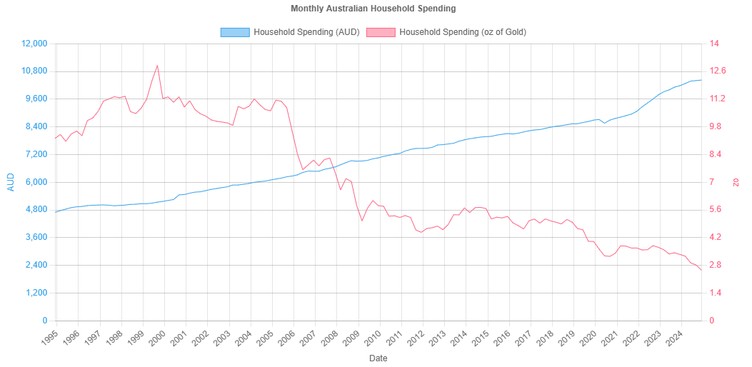
Besides building his businesses, Keith found a secure place to store his wealth and protect his purchasing power with gold. For much of the 1980s to the early 2000s, gold didn’t do much. That was because the Australian economy, and that of the global economy, was relatively robust, despite two recessions. However, as debt growth accelerated through government deficit spending, business failures and bailouts, and household credit loosened, gold took off too.
When gold rallied, people’s purchasing power was quietly declining. Here’s a chart showing roughly how monthly household spending varied in Australian dollar and gold terms:
Source: GoldHub Australia
[Click to open in a new window]
The cost of living increased over time. People are used to this, it’s a fact of life. However, they gradually realised that their income wasn’t keeping up with the costs, such as housing, healthcare, family, utilities, etc., were all increasing. These are fixed expenses, to a large extent. To make ends meet, they resorted to more borrowing and reducing their quality of life.
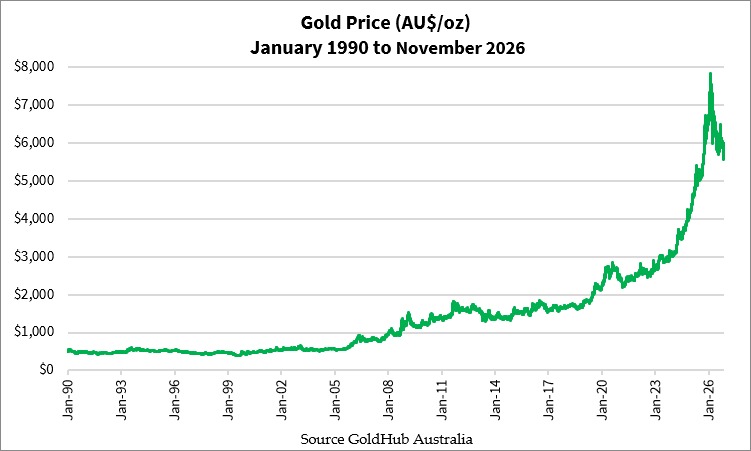
If people had known that gold could preserve one’s purchasing power earlier, things could be quite different. They could have set aside a small amount of their savings in gold and kept up with the rising costs of almost everything.
[Click to open in a new window]
The meteoric rise in the price of gold from August 2005 to September 2011, May 2019 to August 2020, and from March 2024 to January 2026 isn’t so much because gold became more valuable. Rather, excessive borrowing by governments, businesses, and households led to unprecedented currency creation, causing a devaluation of global currencies. Even the sharp decline in gold in the last nine months doesn’t reverse what has happened. It’s merely a pause.
That is the hidden secret in plain sight. Many measure everything in terms of the dollar. However, the dollar is unstable and is consistently losing value.
When one learns to place their wealth in something more stable that preserves value, they travel on a different path. They’re on more solid ground.
If more Australians can do the same, they could feel more in control of their own finances and their lives. Who knows, the country’s future could be much brighter.
The decline of David Jones may be a sad day for Australia. However, it needn’t contribute to the story of our country’s decline. Rather, it could be a wake-up call for middle Australia to rethink not only where they shop, but how they save.
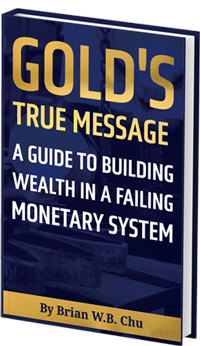
I recently drafted a strategy guide for Australians to learn about how to take their financial destiny into their own hands. I call it The Go Your Own Way Blueprint. It outlines how gold, silver and mining stocks can be valuable additions to one’s investment portfolio to protect and grow one’s wealth. Along with that, you can read my recently published book, Gold’s True Message: Building Wealth in a Failing Monetary System. This is a comprehensive guide to precious metal assets and how to invest in them, drawing on my insights and personal experience in this space.
To learn more about this, please click here and start your journey to change your life around. Remember it’s not just about what you earn and where you shop, but how you save and build your future.
I hope you enjoyed this article. Australia may be looking grim but don’t give up on the country. Play your part by making the deliberate decision to become part of its turnaround.
Have a good weekend ahead!
God Bless,
Brian Chu,
Gold Stock Pro and The Australian Gold Report




Comments