


If the Iran conflict has confirmed one thing, it’s that modern warfare has changed forever. Cheap drones have upended the battlefield — and now markets.
Many of us already knew this from Ukraine. But if you were blissfully unaware, I’m sure your last trip to the petrol pump made it clear.
Like Ukrainian and Gulf cities, global markets are now shuddering under the dark pall of drone strikes.
The major threat right now is Iran’s Shahed Kamikaze drone. A drone which was said to be ‘as easy as producing bicycles’ by Iran’s former Islamic Revolutionary Guard leader.

Source: PhenomenalWorld
These drones are now raining across the Middle East, hitting military and civilian targets alike. The goal is maximum pain, across the region, and beyond.
Middle East air defences are working overtime, but it’s still not enough.
They’ve hit bases, refineries, pipelines, hotels, airports, power plants — even ships, effectively threatening the Strait of Hormuz.
And the result is energy prices at levels not seen since the early days of the Ukraine invasion.
It’s not just the damage these drones can do. It’s what it costs to stop them.
The Math Doesn’t Work
Billion-dollar air defence systems are under strain.
Most interceptions have succeeded. But the sheer volume means Tehran often eventually gets its target.
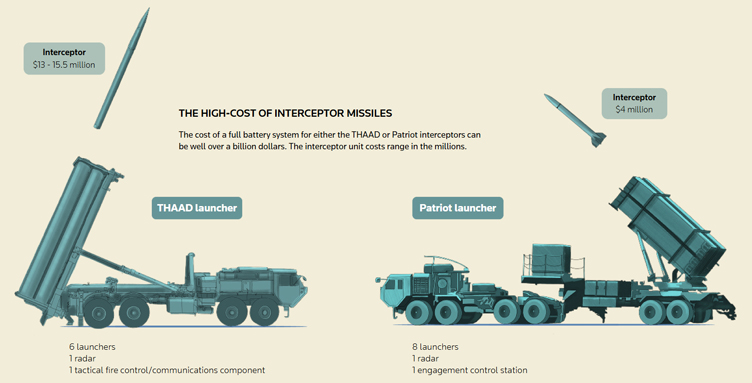
Then there’s the cost. In the first four days of strikes against Iran, the US reportedly spent nearly US$11 billion on interceptors alone.
Patriot missiles cost upwards of $4 million each. The drones they’re swatting out of the sky? Tens of thousands of dollars.
Source: Reuters
[Click to open in a new window]
Tehran is essentially trading aluminium tubes and explosives for the Gulf’s defence budgets.
This is the asymmetric cost problem that has haunted militaries for years. And it’s only getting worse as these drones proliferate.
Below is an inside look at a factory creating the copycat Geran-2 drones, which Russia modelled off the Shahed.

Source: Звезда
Even the US has reverse-engineered the Shahed concept for its own arsenal, which tells you everything you need to know about how the drone economy has shifted.
The point of telling you all this is simple. Drones are everywhere. In every conflict.
To me, that’s a problem. And thankfully, it’s one where the ASX has solutions.
The ‘Five-Year’ Promise
For decades, the answer to these kinds of threats was supposed to be lasers.
High-energy laser weapons that could shoot down drones at the speed of light, for pennies per shot. No ammunition to reload.
The problem with this idea is that laser weapons have been ‘five years away’ for more than four decades.
President Reagan first pitched the idea in 1983. The Pentagon has been chasing the dream ever since.

Source: Time | 1983
The reality today is that only 20–30 laser systems are actually deployed across the US military. Not exactly the revolution we were promised.
But the technology has reached an inflection point in recent years. Huge improvements in optics and thermal systems have turned this 80s dream into a reality.
Now the Pentagon says it wants directed energy weapons ‘at scale’ within three years.
The Army is drafting requirements for its first laser program of real scope. The US Navy is talking about putting a laser on every ship.
The appeal is clear. A laser shot costs little more than the electricity to generate the beam.
Plus, advances in power systems and AI-assisted targeting have made these systems compact enough for real-world combat.
Not a Silver Bullet
Laser weapons have real limitations, though. They require several seconds of sustained ‘contact’ with a target to destroy it.
Meaning, they can only engage one threat at a time. In a swarm attack, that’s a problem.
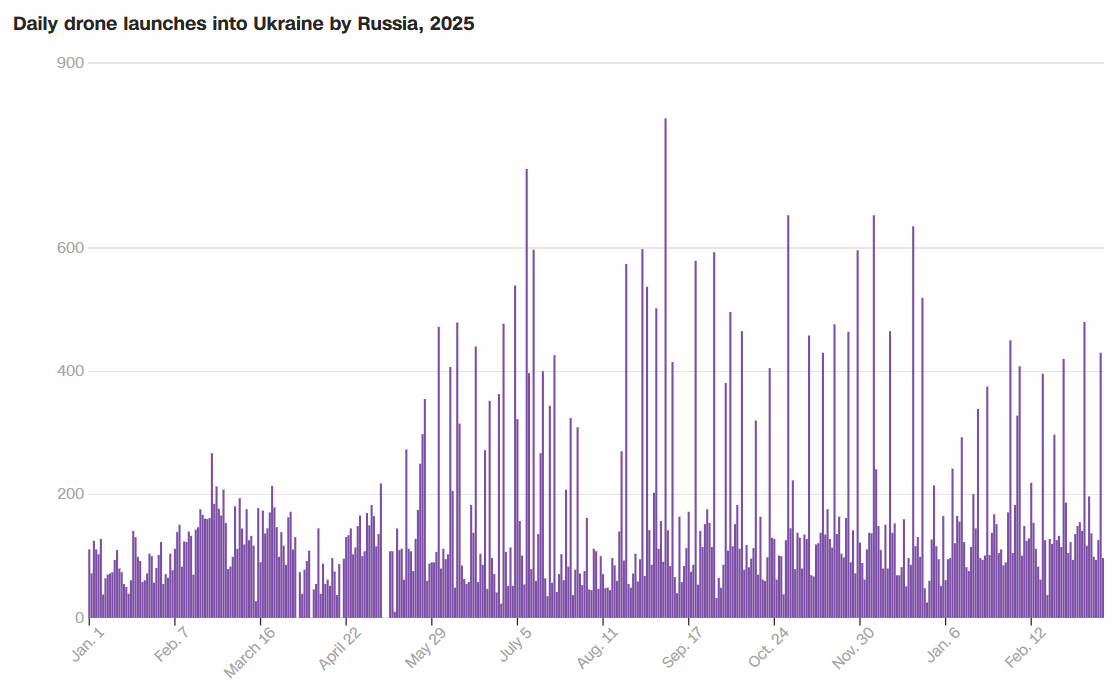
You only need to look at the hundreds of daily strikes into Ukraine to see the scale of the challenge.
Source: CNN
[Click to open in a new window]
Continuous firing in these swarm situations also causes intense heat buildup, forcing pauses. So, the idea of an ‘infinite magazine’ doesn’t hold up in sustained combat.
They also underperform in poor weather. Fog, rain, and dust all reduce effectiveness from 5km to practically zero.
For now, lasers work best as one layer of a broader air defence system. Paired with traditional interceptors for the threats that slip through.
One ASX Company Doing Both
Which brings me to Electro Optic Systems [ASX:EOS].
EOS is one of the few companies globally building both sides of this equation.
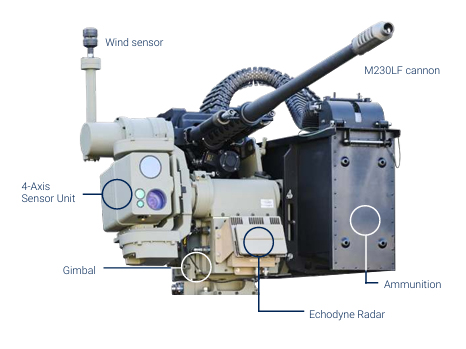
Its Slinger (bullet) remote weapon systems are already deployed with NATO allies and Middle Eastern customers, with an unconditional order book of $459 million.
Source: EOS | Slinger R400
But it’s the laser side that represents the longer-term opportunity for anti-drone technology.
EOS landed the world’s first export contract for a 100-kilowatt class high-energy laser weapon with the Dutch government, potentially worth €71 million.
It’s one of only two companies globally operating at that power level. And this scale.
In February, it opened a new factory in Singapore capable of producing 20 to 40 laser weapons per year.
The company is also building space control systems and exploring integration with the US Golden Dome missile defence shield.
Its recent acquisition of MARSS also gives it a credible AI growth pathway. Bringing its advanced AI-driven command and control capability to tie it all together.
The Investment Case (is not today)
I originally flagged EOS for subscribers back in April 2025 when it traded at $1.08. It’s since risen 800%. At current prices, the stock looks stretched.
That’s no great surprise considering the geopolitical backdrop.
The company is still loss-making, with revenue of $128.5 million against a break-even point of around $200 million.
Guidance for 2026 sits between $180 million and $230 million, which gets them closer. But profitability isn’t here yet.
After riding high, the stock has recently pulled back. This was triggered by the CEO announcing plans to sell up to $26.8 million in shares to fund a divorce settlement and a new house.
This echoes the Droneshield CEO’s share dump in 2025, which sent that stock down over 70%. While EOS might not fare the same, I believe this stock may have further to fall.
Pressure to perform after a recent short-seller attack has put short term pressure on the company.
Added to that is the eventual resolution to the Iran conflict, which could also send defence stocks lower.
If EOS were to fall to $5–6, this one could be worth a serious look.
The future of warfare is cheap. EOS is building the tools to counter it.
The question is whether the price lets you in.
Regards,

Charlie Ormond,
Small-Cap Systems and Altucher’s Investment Network Australia




Comments